
Register for FutureLink Barcelona 2026 Today→
TraceLink — Network for Greater Good
AI Mode Agents AI Solutions Network Resources About
LOG IN TraceLink Classic OPUS Platform
Resources

Breadcrumb

  1. Home
  2. Resources
  3. Resource Center

Sink or Swim? IDC Survey Reveals Who Will Win in the Age of Pharma Supply Chain Disruption

banner-image
  • Download PDF
  • Share
    • LinkedIn
    • Facebook
    • Mail
    • Twitter

Table of contents

Key Takeaways

  • Nearly half of pharma supply chain companies lack the resilience needed to effectively respond to major disruptions.
  • Only 5.6% of pharma supply chain companies say they are actively pursuing patient-centric transformation strategies. 
  • Collaborating more closely with partners on a digital supply network can help organizations boost agility, responsiveness, and resilience.

COVID-19 ignited a chain reaction of disruption across the global pharma industry that led to drug shortages, rising costs, and a sharp decrease in the rate of on time, in full (OTIF) deliveries of medicines to patient in need—and companies can expect these kinds of disruptions to continue until long after the pandemic subsides, according to a new survey report from analyst firm IDC.

Whether it’s a new pandemic or another major source of disruption, the pharma supply chain companies poised for success will be those that view COVID-19—and the critical weaknesses it shined a light on—as motivation for embracing patient-centric, agile supply chain principles.
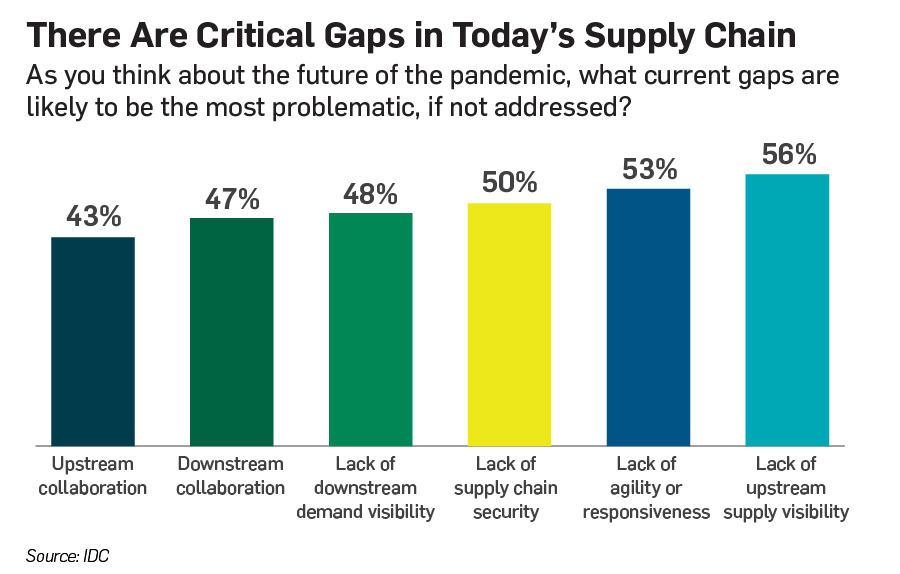
IDC Blog Chart Critical Gaps in Today's Supply Chain

“The companies who are going to do better are going to transform their operating models from supply-driven to patient-driven,” predicts IDC Program Vice President and Supply Chain Strategies Practice Leader Simon Ellis, who presents the survey results in a new TraceLink on-demand webinar. “Companies that use data better and are able to link data to outcomes—in this case, patient outcomes—will outperform those that are not. It's about prioritizing resiliency."

IDC and TraceLink surveyed 532 companies across the end-to-end supply chain—including manufacturers, CMOs, wholesalers, and pharmacies—and found that the industry as a whole is in reactive mode and lacks the resilience required to maintain a high level of performance in the face of disruptions like those caused by COVID-19. Among the survey results:
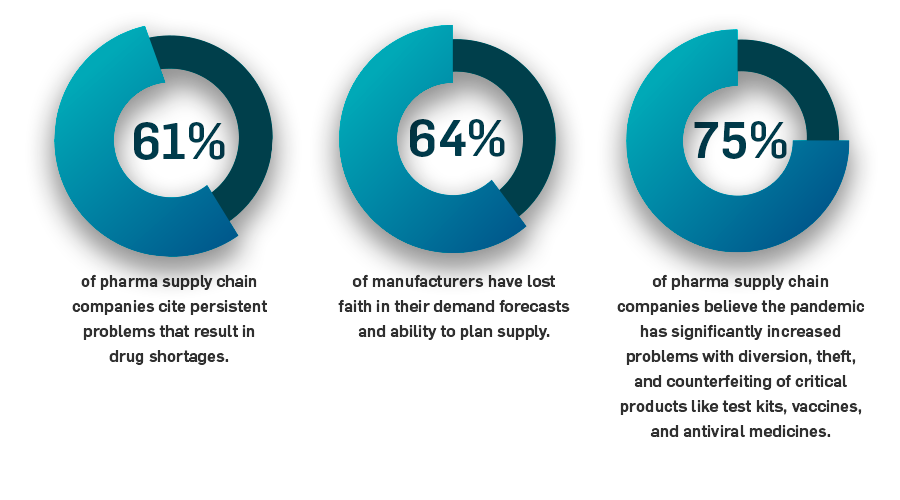
IDC StatsAdditionally, the survey revealed that only a handful of respondents—just 5.6%—are currently reengineering operating models to build a more patient-driven supply chain.

Who will succeed—and who will fail—in the era of supply chain disruption?
During the webinar, Ellis offers a list of the key characteristics that IDC believes will be crucial to achieving success in the era of increasing supply chain disruption. Companies poised for success will:

  • Use the pandemic as a wake-up call that fuels the energy, urgency, and commitment needed to digitally transform the business and make agile patient service a top priority.
  • Analyze current capabilities, identify major weaknesses exposed during the pandemic, and make fixing them a priority. For example, improving the ability to share accurate and actionable data for upstream and downstream supply chain visibility.
  • Plan holistically for transformation across all functional departments and investigate platforms that enable the integration of planning and operations across the end-to-end demand and supply network.
  • Focus on providing a resilient, responsive, reliable, and compliant product supply that enables the business to meet agreed-upon service levels.
  • Collect and analyze downstream demand data from various sources to improve demand forecast accuracy and plan the product supply network.
  • Strive to be digital pioneers by transforming operating models from supply-driven to patient driven.

Companies poised to struggle will:

  • Deploy local, siloed improvement solutions and fragmented fixes for supply chain disruptions.
  • Stick with traditional operational enterprise software vendors with limited cognitive and augmented analytics capabilities.
  • Focus only on creating inventory stockpiles to help ensure agility.
  • Fail to diversify agile supply management to multiple tiers.
  • Behave like “digital laggards” and lack a well-defined digital transformation plan.
  • Manage supply chain risk management by focusing solely on the reaction to a disruptive event, as opposed to taking proactive steps to avoid disruptions.
  • Operate in supply-driven internal and external silos that are unable to share data and collaborate across functions and partners in the network.

“Hopefully, we won't have another pandemic for another hundred years, but there are other things coming. The disruptive nature of the supply chain appears to be with us now for a while,” Ellis said. “The kinds of things that are necessary to be resilient won't just help companies with COVID-19, it will help them with the other things that are on the horizon.”

Watch our on-demand webinar featuring IDC’s Simon Ellis to learn more.

<a href="/category/blog" hreflang="en">Blog</a><a href="/category/supply-chain-collaboration" hreflang="en">Supply Chain Collaboration</a><a href="/category/supply-chain" hreflang="en">Supply Chain</a>

Table of contents

Subscribe to Agile Supply Chain Insights
Stay informed with the latest patient-centric agile supply chain thought leadership content.
SUBSCRIBE
Subscribe to Agile Supply Chain Insights
Stay informed with the latest patient-centric agile supply chain thought leadership content.
 

Thank you for contacting us; we’ll be in touch shortly.

Related Content
thoughtleadership_supplychain_tablet_warehouse_3.jpg
Special Episode: IDC on Winning Strategies for Increasing Resilience in the Face of Supply Chain Disruptions
Get expert advice from IDC on what it takes to boost supply chain resiliency and respond effectively to supply chain disruptions like those caused by COVID-19.
View More
thoughtleadership_globalnetwork.jpg
IDC: These 3 Capabilities Will Help You Increase Supply Chain Agility
IDC shares the top capabilities you need to achieve supply chain agility in the pharmaceutical industry. Read it now.
View More
digital-transformation-3.png
Are Data Silos Hindering Your Supply Chain Visibility? IDC Explains Why Pharma Supply Chains Need a Single Source of Truth
Traditional enterprise systems may be stifling your supply chain visibility, according to IDC. Find out what it will take to knock down the information silos.
View More

Cookie Settings

When you visit any website, it may store or retrieve information on your browser, mostly in the form of cookies or similar tracking technologies. Please see below for an overview of the categories of cookies and similar technologies used on this site. You can allow or deny some of all of them, except Strictly Necessary Cookies which are required to provide the site to you. However, blocking some types of cookies may impact your experience of the site and services we are able to offer.

Please see our Cookie Policy for more details, including a list of the cookies we use. You can change your consent options at any time by following the “Cookie Settings” link in the Cookie Policy.
'Strictly Necessary' cookies let you move around the Site and use essential features like secure areas, shopping baskets and online billing. Without these cookies you would not be able to navigate between pages or use certain vital features of our Site, so we do not require your consent for their use. These cookies don't gather any information about you that could be used for marketing or remembering where you've been on the internet. For example, we use these Strictly Necessary cookies to identify you as being logged in to the Site. You can set your browser to block or alert you about these cookies, but if you do so, some parts of the Site will not work.
'Performance' cookies collect information about how you use the Site, such as which pages you visit, the time spent on the Site and if you experience any errors. We use performance cookies to provide aggregated statistics on how the Site is used and help us improve the Site including by measuring any errors that occur.
'Functional' cookies are used to provide services or to remember settings to improve your visit. We use 'Functionality' cookies to remember your settings and choices and show you when you're logged in to the Site.
‘Targeting' cookies are linked to services provided by third parties, such as 'Like' buttons and 'Share' buttons. The third party provides these services in return for recognizing that you have visited the Site. We also use 'Targeting' cookies to gather information that could be used to display content that we think may interest you.
Register for FutureLink Barcelona 2026 Today→
TraceLink — Network for Greater Good
Log In OPUS Platform · TraceLink Classic
AI Mode
Featured Report The Agentic Supply Chain Operating Model →

Agentic Business Processes

External Manufacturing Logistics Transportation Commerce Compliance

Products

Digital Transaction Exchange Process Collaboration Global Track-and-Trace Regulatory Compliance Real-Time Intelligence

Resources

Resource Center TraceLink University Partners Community Customers Events

About TraceLink

Company Overview Newsroom Culture & Careers Open Jobs Legal & Trust Center Corporate Social Responsibility Network Directory Glossary

Hot Topics

Eliminate Stockouts Improve OTIF Reduce Costs Increase End-to-End Visibility Accelerate Order-to-Cash Optimize Inventory Levels Scale Cross-Partner Execution
Need assistance? Contact Technical Support→

Contact Us Today

Transform your supply chain operations with a human-agent workforce.

Contact Us →

Stay Up-to-Date

Subscribe to receive industry insights and evolving trends.

Thanks — you're subscribed.

© TraceLink Inc. 2009–2026 All Rights Reserved