

Agentic Business Processes for the End-to-End Supply Chain
Transform supply chain work with Agentic Business Processes
An Agentic Business Process integrates OPUS Agents, MINT B2B transactions, POET collaborative business processes and Melody Actions into a real-time operating model for performing work.
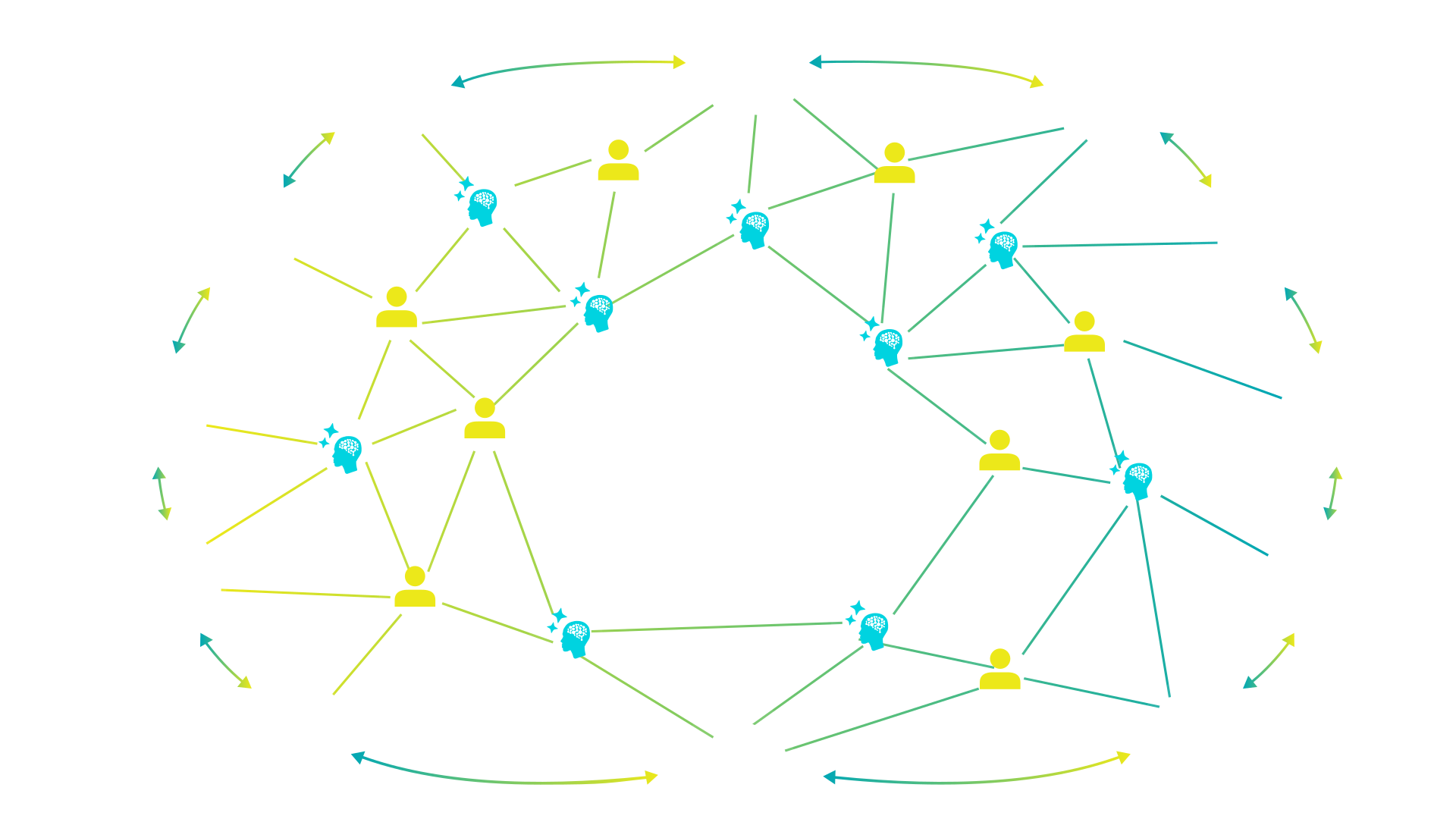
Built on TraceLink’s Agentic Supply Chain Operating System, each Agentic Business Process enables human teams and governed OPUS Agents to work together across companies, systems, and trading partners—using shared information, intelligence, and reasoning to perform work faster and more effectively.
Together, these Agentic Business Processes put the Agentic Supply Chain Operating Model into practice, helping companies operate with greater intelligence, agility, and scale as AI becomes part of how supply chain work is performed.

Business processes organized by operational orchestration
Every organization performs hundreds of business processes. TraceLink organizes Agentic Business Processes into operational orchestrations that reflect how work is performed across the end-to-end supply network.
Agentic Business Processes in practice
You build the workforce your business goals and operating model call for. Each process below names the trading relationship it governs, the steps it spans, and examples of the kinds of agents you can employ inside it.
The commercial lifecycle that turns a customer purchase order into cash collected and reconciled, across the manufacturer, the wholesaler or dispenser, and third-party logistics providers.
Teams hand-gather approval evidence across disconnected systems while valid orders wait. Underpriced or off-contract orders ship before anyone catches the variance, scarce supply gets committed to the wrong customers, and the cost surfaces later as chargeback disputes, credits, and audit findings.
The agent validates every purchase order against approved pricing, contract terms, allocation and forecast, recent shipment activity, and ordering history before it is released. One consistent decision gate, with a traceable rationale and the decision still made by a person.
Acknowledgement performance is measured after the fact, if at all. A missed response surfaces when the customer escalates, and no one can say how often it happens or which accounts it affects.
The agent tracks every order and line item against the acknowledgement SLA agreed with each customer, and flags what is late or missing while the window is still open.
Fulfillment problems surface when the customer calls. Order management checks shipment status one order at a time, and shortfalls, overages, wrong products, and split shipments are found after the delivery window has closed.
The agent compares every purchase order against the shipment activity behind it and flags risks to on-time, in-full delivery while there is still time to act. Discrepancies open a resolution workflow with the warehouse or distribution center.
The procurement lifecycle that turns a purchase requirement into product received, invoiced, and paid, across the buyer, its suppliers, and the logistics providers between them.
Orders are placed on the assumption that the price and quantity are right. Off-contract pricing and duplicate orders are discovered downstream as invoice disputes, credits, and returns.
The agent checks each order against contract pricing and ordering history before it is sent, so pricing errors and duplicates are corrected at the point of origin rather than argued over after delivery.
Accounts payable reconciles invoices to orders by hand, and only samples the rest. Overbilling that clears the threshold gets paid, and recovering it later costs more than catching it would have.
Every invoice is matched line by line against the order and the contract price before payment is released, with a recommendation to pay, hold, or investigate and the evidence attached.
Nobody notices the remittance advice that never arrives. The gap turns up in a month-end reconciliation, by which time the supplier conversation starts from scratch.
The agent watches each invoice for its matching remittance record against the agreed SLA and raises the ones that are missing or late, while the transaction is still fresh.
Deductions arrive without a clear line back to the order or dispute that created them. Tracing one takes hours across systems, so most are absorbed rather than challenged.
The agent reconstructs the chain from deduction to memo to cleared invoice to originating order, and presents findings with recommended next steps for authorized review.
The U.S. contract pricing lifecycle, where wholesalers sell product to contracted providers at the contract price and claim the difference back from the manufacturer as a chargeback.
Chargeback volume outruns the team that reviews it. Sampling lets invalid claims, duplicates, and resubmissions through, and each one is a credit issued against a price that was never authorized.
Every request is checked against the authorized contract price and the chargeback history behind it, and classified before a credit is issued. Duplicates and resubmissions are identified as such rather than paid twice.
Response windows differ by wholesaler and are tracked in spreadsheets. A response sent late or missing its credit memo number becomes a dispute, and the dispute becomes a deduction.
The agent holds every claim against its wholesaler-specific window and business requirements, and flags responses that are missing, incomplete, or misaligned before the window closes.
Wholesaler deductions rarely match the credits the manufacturer expected. Reconciling them means rebuilding the chain by hand, so variances are accepted as the cost of doing business.
The agent traces each deduction back through the credit memo, the response, and the original request to the settlement date, and reports what does not reconcile with the evidence attached.
The commercial lifecycle between a marketing authorization holder and its contract manufacturers, from purchase order through acknowledgement, production, invoice, and payment.
External manufacturing invoices carry batch quantities, materials, and services that rarely map cleanly to the order. Verification is manual, slow, and selective, so variances are paid.
Each invoice is matched against its purchase order before payment, with a recommendation to pay, hold, or investigate and the discrepancy identified line by line.
An unacknowledged purchase order looks identical to an accepted one until production is already late. Supply managers chase acknowledgements by email, partner by partner.
The agent tracks every order and line item against the acknowledgement SLA and surfaces what has not been confirmed, so supply risk is visible weeks before the delivery date.
Payment and remittance drift apart across currencies, sites, and payment runs. Partners chase status, and finance rebuilds the picture at month end.
The agent watches each invoice for its matching remittance record against the agreed SLA and raises the gaps early, so partner queries are answered from a reconciled position.
The same commercial lifecycle seen from the contract manufacturer’s side, from customer purchase order received through acknowledgement, production, shipment, and settlement.
Client service agreements set response windows the customer service team cannot see in one place. Missed acknowledgements become client escalations and contract penalties.
The agent measures every incoming client order against its committed response window and flags what is outstanding, so acknowledgement performance is managed rather than reported on.
Fulfillment status lives in the site systems and reaches the client only when someone asks. Partial and late shipments are explained after the fact.
The agent compares acknowledged orders to shipment activity and flags shortfalls and delays as they emerge, so the client conversation happens before the delivery date, not after it.
The reconciliation of inventory ownership, location, quantity, and status between a marketing authorization holder and the contract manufacturing partners holding its materials and product.
Each client keeps its own view of the stock the site holds, and disagreements surface as disputes over what is owned, where it sits, and whether it is releasable.
The agent reconciles client-reported balances against the site records continuously, so ownership, location, and status differences are resolved as operational items rather than client disputes.
The reconciliation of inventory ownership, location, quantity, and status between a marketing authorization holder and the contract manufacturing partners holding its materials and product.
Expiry is reviewed when someone thinks to look. Material that could have been redistributed is written off after the date has passed.
The agent reads every balance report for material approaching or past expiry and recommends rotation, redistribution, return, or disposal while the stock still has value.
The outbound fulfillment lifecycle executed by third-party logistics providers on behalf of a marketing authorization holder, from warehouse ship order through shipping advice and customer delivery.
The provider reports what shipped after it shipped. A missing shipping advice is indistinguishable from a shipment that did not happen, and the customer finds out first.
The agent matches every warehouse ship order to the shipping advice behind it and flags what is missing, short, over, wrong, split, or late, so the exception is worked before the delivery window closes.
The reconciliation of inventory quantity, location, and status between a marketing authorization holder and the third-party logistics providers holding its product.
Provider inventory files arrive in different formats on different cycles. Reconciliation happens at period end, and available-to-promise is based on a number nobody has verified.
The agent compares provider-reported balances against the MAH records on every report and raises quantity, location, and status differences with the evidence behind them.
Short-dated stock is found during a cycle count or a customer rejection. By then the options are narrower and the write-off is larger.
The agent reads every provider balance report for product approaching or past expiry and recommends rotation, redistribution, return, or disposal while the stock is still sellable.
Every Agentic Business Process is designed to deliver measurable outcomes
Each TraceLink solution is designed around a defined business outcome and measured by its impact on productivity, revenue, service, cost, cash, and risk. The specific measures vary by Agentic Business Process, giving organizations a clear way to evaluate operational and financial value.

Transform the future of operational work
Through Agentic Business Processes, people and governed OPUS Agents continuously collaborate across every supply chain orchestration, enabling organizations to build more intelligent, resilient, and adaptive supply networks.
Cookie Settings
Please see our Cookie Policy for more details, including a list of the cookies we use. You can change your consent options at any time by following the “Cookie Settings” link in the Cookie Policy.