
Home
  • AI Mode
  • Supply Chain Orchestration
    fast
    Supply Chain Orchestration
    • Life Sciences Company
    • Direct Material Supplier
    • Contract Manufacturer
    • Third Party Logistics
    • Wholesale Distributor
    • Healthcare Provider
    • Retail Pharmacy
  • Network
  • Products
    fast
    Products
    • Multienterprise Information Network Tower (MINT)
    • Process Orchestration for Empowered Teams (POET)
    • Track-and-Trace
  • Resources
    fast
    Resources
    • Resource Center
    • TraceLink University
    • TraceLink Glossary
    • Partners
    • Community
    • Events
    • Customers
  • About
    fast
    About
    • Our Story
    • Newsroom
    • Culture and Careers
    • Leadership
    • Our Values
    • Corporate Social Responsibility
    • Contact Sales
  • Log In
    • Tracelink Classic
      TraceLink Classic app.tracelink.com
      Redirect
    • Opus Platform
      Opus Platform opus.tracelink.com
      Redirect
Log In
  • Tracelink Classic
    TraceLink Classic app.tracelink.com
    Redirect
  • Opus Platform
    Opus Platform opus.tracelink.com
    Redirect
Resources

Breadcrumb

  1. Home
  2. Resources
  3. Resource Center

Pharmacy Packaging is Changing. Will You Be Ready?

banner-image
  • Download PDF
  • Share
    • LinkedIn
    • Facebook
    • Mail
    • Twitter

Table of contents

As required by DSCSA, most prescription drug products manufactured after November 2017 must display a serialized product identifier on every saleable item. As packaging bearing new barcodes and serial numbers begin to appear on receiving docks and store shelves, pharmacies are assessing their digital strategies and how they will integrate serialized product data into their operations.

What is a 2D Data Matrix?

The terms 2D Data Matrix and 2D Barcode are often used interchangeably, but the 2D GS1 Data Matrix has been adopted by the industry as the “machine-readable data carrier” required by the FDA as part of the product identifier. In the US, the product identifier comprises the 2D Data Matrix and the four required data elements in human-readable form: The Global Trade Identification Number (GTIN), Serial Number, Expiration Date, and Lot Number. The GTIN includes the US National Drug Code (NDC) of the product.
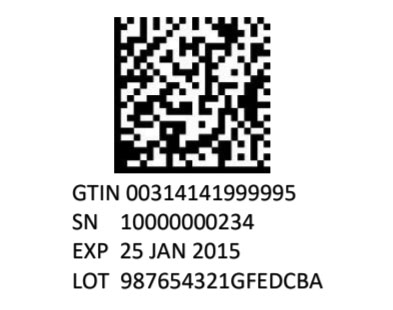
DSCSA compliant GS1 Product Identifier with 2D data matrix

The 2D Data Matrix offers several advantages over the more familiar linear barcode format. They can store far more data than a linear barcode in a much smaller space, an important consideration in product packaging and labeling. They are also easier to scan, and less prone to scanning errors. However, they must be scanned using an image scanner; laser scanners cannot read a 2D Data Matrix.

New technologies, new possibilities

Pharmacies will continue to see products with multiple barcodes—2D barcodes as well as linear barcodes—as the industry adapts to the new regulations and as manufacturers weigh the benefits of having more space on their packaging for branding or consumer messaging: the ability to scan a 2D barcode with a smartphone opens up new possibilities for customer interaction and patient safety.

But pharmacies are also beginning to recognize the potential business value of the the data contained in the 2D Data Matrix in their own operations:

  • The expiration date, when associated with a serial number, can be used to manage product rotation and inventory from the distribution center to individual pharmacy locations.
  • The serial number provides a unique product identifier that can be used to track product receipt, distribution, and disposition at the saleable item level, and to verify that the product is in a “dispensable state” and not stolen, recalled, or withdrawn from the market.
  • Product identification at the saleable item level, rather than at the lot level, streamlines key provisions of the DSCSA that affect pharmacies: product tracing, product verification, detection and response, and notification. Serialized products will enable more rapid and thorough product recalls.
  • Serialized data can be used to track or trace the physical movement and status of products as they travel throughout the supply chain using EPCIS, an open GS1 digital data standard that enables supply chain partners to access transaction histories over a network—replacing manual, paper-based T3 processing and storage.


Planning—and scanning—for success

Manufacturers may or may not choose to replace linear barcodes with 2D barcodes. Pharmacies and healthcare systems need to plan for this uncertainty and for the possibility that their current scanning and data systems will not be able to read 2D Data Matrix barcodes. Switching to “smart” scanners that can read multiple barcode formats will allow pharmacy operations to capture and process serialized data “at the edge” and connect to an information-sharing network, where data can be shared with supply chain partners and accessed quickly for product verification and track-and-trace processes.

TraceLink serialization and scanning solutions

TraceLink is leading the industry in helping pharmacies take full advantage of DSCSA-originated serialization data with solutions like Serialization Operations Manager (SOM) and Edge Track scanning technology, designed to integrate with existing ERP and inventory management systems, capture serialized product data as it moves through the enterprise, and connect directly to the TraceLink network.

Every day, thousands of hospital and pharmacy locations rely on the TraceLink network to exchange information with drug suppliers and partners with just a single connection, protect patients from counterfeit drugs, and adhere to legal requirements. Learn more about healthcare and pharmacies on the TraceLink network.


BlogDSCSA for DispensersRegulatory/ComplianceUnited States

Table of contents

I'd like to learn more about serialization solutions from TraceLink.
Contact us
I'd like to learn more about serialization solutions from TraceLink.
 

Thank you for contacting us; we’ll be in touch shortly.

More Serialization and Compliance Resources
dispenser-with-patients.png
Four Ways to Modernize Pharmacy Operations with a Serialized Inventory
Modernize your pharmacy operations. Support DSCSA compliance, manage recalls, confirm purchase orders, and more with a serialization inventory.
View More
futureofpharmacy_email_thumb.jpg
The Pharmacy of the Future: Embracing the Digital Transformation
How can you get new business value from your investment in serialization? Start here.
View More

Cookie Settings

When you visit any website, it may store or retrieve information on your browser, mostly in the form of cookies or similar tracking technologies. Please see below for an overview of the categories of cookies and similar technologies used on this site. You can allow or deny some of all of them, except Strictly Necessary Cookies which are required to provide the site to you. However, blocking some types of cookies may impact your experience of the site and services we are able to offer.

Please see our Cookie Policy for more details, including a list of the cookies we use. You can change your consent options at any time by following the “Cookie Settings” link in the Cookie Policy.
'Strictly Necessary' cookies let you move around the Site and use essential features like secure areas, shopping baskets and online billing. Without these cookies you would not be able to navigate between pages or use certain vital features of our Site, so we do not require your consent for their use. These cookies don't gather any information about you that could be used for marketing or remembering where you've been on the internet. For example, we use these Strictly Necessary cookies to identify you as being logged in to the Site. You can set your browser to block or alert you about these cookies, but if you do so, some parts of the Site will not work.
'Performance' cookies collect information about how you use the Site, such as which pages you visit, the time spent on the Site and if you experience any errors. We use performance cookies to provide aggregated statistics on how the Site is used and help us improve the Site including by measuring any errors that occur.
'Functional' cookies are used to provide services or to remember settings to improve your visit. We use 'Functionality' cookies to remember your settings and choices and show you when you're logged in to the Site.
‘Targeting' cookies are linked to services provided by third parties, such as 'Like' buttons and 'Share' buttons. The third party provides these services in return for recognizing that you have visited the Site. We also use 'Targeting' cookies to gather information that could be used to display content that we think may interest you.

Footer

  • Quick Links
    Get a Demo
    TraceLink Network Directory
    The Network
    OPUS Platform
    Technical Support
    Open Jobs
    API: Terms of Use
  • Products
    Multienterprise Information Network Tower
    U.S. DSCSA Compliance
    Targeted Recalls
    Process Orchestration for Empowered Teams
    Serialization
    Global Compliance
  • Resources
    Resource Center
    Events
    TraceLink University
    Partners
    Community
  • About TraceLink
    Our Story
    Newsroom
    Culture & Careers
    Leadership
    Our Values
    Corporate Social Responsibility
  • Hot Topics
    Transaction Integration
    Supply Chain Visibility
    DSCSA Compliance
    Process Orchestration
    Kazakhstan Compliance for Pharmaceuticals
    Kyrgyzstan Compliance for Pharmaceuticals
Follow Us on Social
Facebook
Linkedin
X
Legal & Trust.
© TraceLink Inc. 2009-2026 All Rights Reserved
Contact Us Today
Contact us today to begin your journey toward agentic supply chain orchestration — digitalize your end-to-end supply chain with intelligence, flexibility, and collaborative orchestration.
Contact Us
Stay Up-to-Date
Subscribe to receive industry insights and stay at the forefront of evolving trends.
Subscribe