
Home
  • AI Mode
  • Supply Chain Orchestration
    fast
    Supply Chain Orchestration
    • Life Sciences Company
    • Direct Material Supplier
    • Contract Manufacturer
    • Third Party Logistics
    • Wholesale Distributor
    • Healthcare Provider
    • Retail Pharmacy
  • Network
  • Products
    fast
    Products
    • Multienterprise Information Network Tower (MINT)
    • Process Orchestration for Empowered Teams (POET)
    • Track-and-Trace
  • Resources
    fast
    Resources
    • Resource Center
    • TraceLink University
    • Partners
    • Community
    • Events
  • About
    fast
    About
    • Our Story
    • Newsroom
    • Culture and Careers
    • Leadership
    • Our Values
    • Corporate Social Responsibility
    • Contact Sales
  • Log In
    • Tracelink Classic
      TraceLink Classic app.tracelink.com
      Redirect
    • Opus Platform
      Opus Platform opus.tracelink.com
      Redirect
Log In
  • Tracelink Classic
    TraceLink Classic app.tracelink.com
    Redirect
  • Opus Platform
    Opus Platform opus.tracelink.com
    Redirect
Resources

Breadcrumb

  1. Home
  2. Resources
  3. Resource Center

Procurement’s Role in Strengthening Supply Chains

banner-image
  • Download PDF
  • Share
    • LinkedIn
    • Facebook
    • Mail
    • Twitter

Table of contents

It’s no exaggeration to say that before the pandemic, few people outside of procurement thought much about supply chains. Now, as a result of various global disruptions, there isn’t a single day that goes by without a significant supply chain headline.

Earlier in June, the Biden administration reported on the findings of Executive Order 14017, “America’s Supply Chains,” its 100-day review of critical supply chains. Based on these findings, the administration intends to take immediate action to further strengthen supply chains and promote economic security, national security, and higher quality employment.

The White House announced immediate action to address vulnerabilities and strengthen resilience to address near-term supply chain disruptions. It identified four priority areas: semiconductor manufacturing and advanced packaging; large capacity batteries, like those for electric vehicles; critical minerals and materials; and pharmaceuticals and active pharmaceutical ingredients (APIs).

“The supply chain reviews reinforce the need for the transformative investments proposed in the President’s American Jobs Plan,” the White House stated.

The focus of the report is on building resilience within the supply chains of the United States itself and reducing reliance on global markets. To this end, it promises that several Federal departments and agencies will work together to “develop comprehensive strategies for revitalizing six industrial bases: defense, public health and biological preparedness, information and communications technology, energy, transportation, and agriculture and food production.”

There is, however, a recognition that there are limits to what can be achieved domestically: the U.S. “must take steps to ensure that the manufacturing and mining that takes place abroad supports supply chain resilience and meets high labor and environmental standards.”

What will all of this mean for procurement professionals in the United States and their counterparts in subsidiaries abroad?

Coronavirus and other disruptions

The coronavirus pandemic has presented a huge challenge to globalization. It’s also been a source of disruption for many procurement professionals, along with other obstacles such as natural disasters and canal blockages. These act as a constant reminder that we need to think again about global supply chains and consider looking for local suppliers through domestic production and nearshoring. When you factor in risk and risk mitigation as costs, “low-cost suppliers” from the other side of the world don’t always add up to a good deal. 

At the same time, there is a danger posed by any return to economic nationalism, which will increase costs, cause further supply chain disruptions, and raise trade barriers. 

After all, problems are springing up everywhere that escape the control of national governments. The Ningbo-Zhoushan in China, the world’s third-busiest container port, was at a standstill after one worker tested positive for coronavirus. The resulting backlog has impacted global supply chains. In California, ports were overwhelmed by a 60% increase in shipping volume (and are still overwhelmed today). There have been lengthy transport stoppages on the Panama Canal due to maintenance work, while in Europe a chronic shortage of lorry drivers (which is also an acute shortage in the UK) is causing delays in road transport deliveries, and a series of strikes by German train drivers has disrupted rail freight. All of this means you may face issues such as late shipments and material shortages, just when demand is increasing. Poor communication among buyers and suppliers, as well as a lack of visibility into the supply chain, can make it so these issues take weeks to resolve. And a lot of these issues are recurring because the information on how to effectively resolve them isn’t being shared among supply chain partners.  

Data, visibility and collaboration are key

But that’s the headlines. Then there are the procurement professionals tasked with actually solving these problems.

All of this presents an opportunity for procurement professionals to step forward and work with business leaders to ensure they understand how the world at large benefits from interdependent global supply chains. 

However, procurement must put itself in a position to act. The greatest challenge within any organization is to detect and respond to supply chain issues in advance. To do this, you need three things: 

  • First, the ability to capture, analyze, and share data on global supply chain movements and disruptions
  • Second, visibility right across your organization into global supply chains with early warnings before issues become acute, and the ability to prioritize
  • Third, structured processes and workflows that enable you to collaborate with internal stakeholders and subject matter experts, suppliers, and customers to resolve the issues

Without these, procurement is likely to be in permanent panic mode, with endless meetings, phone calls, and email exchanges only adding to the confusion. With these, though, you may be able to prevent 35% of supply chain issues from arising in the first place and resolve those that do arise 65% quicker than you can now. What’s more, these figures will improve further as you build up a history of supply chain events and root cause analysis of disruptions.

Integrating advanced digital technologies will help procurement and supply chain professionals weather both localized issues, such as supply chain bottlenecks, and the next global crisis. And in so doing, procurement will play a heroic role in meeting the objectives set out in E.O. 14017. 

TraceLink Supply Chain Issue Management (SCIM) is a collaboration solution for capturing, analyzing, resolving, correcting, and preventing supply chain issues. 

SCIM’s dashboards provide actionable visibility at all levels of the organization and to end-to-end supply chain partners. You can drill down from these dashboards into individual incidents, assign them to the right team of subject matter experts, and start the resolution process. Pre-built incident management processes and a change request process ensure that you can collaborate and report on actions and outcomes across the entire organization.

In a world of increasingly fragile supply chains, supply chain issue management has become imperative. How effectively can you navigate these disruptions?
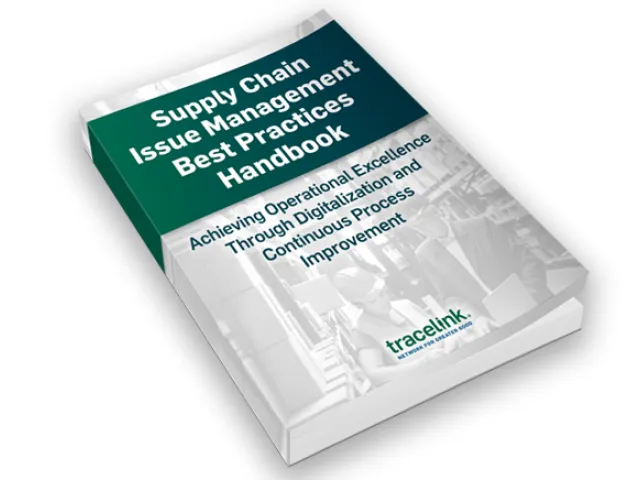
 Download our new handbook for more information on supply chain issue management. 

BlogSupply Chain CollaborationProcurement

Table of contents

Subscribe to Agile Supply Chain Insights
Stay informed with the latest patient-centric agile supply chain thought leadership content.
 

Thank you for contacting us; we’ll be in touch shortly.

Related Content
Supply Chain Issue Management Handbook Cover Image
Supply Chain Issue Management Best Practices: Your Guide to Achieving Operational Excellence Through Digitalization and Continuous Improvement
Learn how manufacturers are achieving up to 82% improvement in delivery performance; up to a 35% reduction in supply chain issues; and up to a 50% reduction in repeat deviations.
View More
Landing Page Image 65 percent Infographic
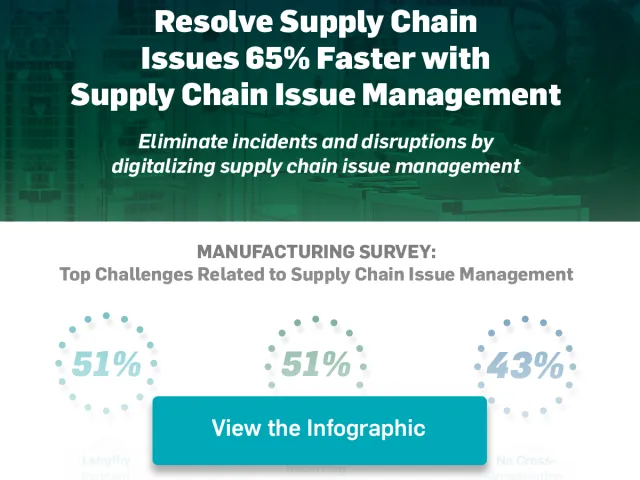
Resolve supply chain issues up to 65% faster with Agile Process Teams for Supply Chain Issue Management (APT-SCIM)
Discover the supply chain issue management platform that improves visibility with real-time dashboards and enables manufacturing organizations to resolve supply chain issues up to 65% faster. View the infographic and download the eBook now.
View More
line-management
The Top Six Supply Chain Issue Management Challenges—and How to Overcome Them
Lengthy issue resolution times top the list of the six biggest challenges to successful supply chain issue management. Get the survey results.
View More
supply-chain-technology
Why the Top Five Forms of Supply Chain Collaboration May Be Slowing You Down
Email and phone calls top the list of supply chain collaboration methods, but they also impede efforts to reduce disruptions. Get the survey results.
View More
Start using SPI quickly
Establishing a Strategic Foundation for Industry 4.0
Learn how Industry 4.0 will transform the supply chain landscape forever.
View More

Cookie Settings

When you visit any website, it may store or retrieve information on your browser, mostly in the form of cookies or similar tracking technologies. Please see below for an overview of the categories of cookies and similar technologies used on this site. You can allow or deny some of all of them, except Strictly Necessary Cookies which are required to provide the site to you. However, blocking some types of cookies may impact your experience of the site and services we are able to offer.

Please see our Cookie Policy for more details, including a list of the cookies we use. You can change your consent options at any time by following the “Cookie Settings” link in the Cookie Policy.
'Strictly Necessary' cookies let you move around the Site and use essential features like secure areas, shopping baskets and online billing. Without these cookies you would not be able to navigate between pages or use certain vital features of our Site, so we do not require your consent for their use. These cookies don't gather any information about you that could be used for marketing or remembering where you've been on the internet. For example, we use these Strictly Necessary cookies to identify you as being logged in to the Site. You can set your browser to block or alert you about these cookies, but if you do so, some parts of the Site will not work.
'Performance' cookies collect information about how you use the Site, such as which pages you visit, the time spent on the Site and if you experience any errors. We use performance cookies to provide aggregated statistics on how the Site is used and help us improve the Site including by measuring any errors that occur.
'Functional' cookies are used to provide services or to remember settings to improve your visit. We use 'Functionality' cookies to remember your settings and choices and show you when you're logged in to the Site.
‘Targeting' cookies are linked to services provided by third parties, such as 'Like' buttons and 'Share' buttons. The third party provides these services in return for recognizing that you have visited the Site. We also use 'Targeting' cookies to gather information that could be used to display content that we think may interest you.

Footer

  • Quick Links
    Get a Demo
    TraceLink Network Directory
    The Network
    OPUS Platform
    Technical Support
    Open Jobs
    API: Terms of Use
  • Products
    Multienterprise Information Network Tower
    U.S. DSCSA Compliance
    Targeted Recalls
    Process Orchestration for Empowered Teams
    Serialization
    Global Compliance
  • Resources
    Resource Center
    Events
    TraceLink University
    Partners
    Community
  • About TraceLink
    Our Story
    Newsroom
    Culture & Careers
    Leadership
    Our Values
    Corporate Social Responsibility
  • Hot Topics
    Transaction Integration
    Supply Chain Visibility
    DSCSA Compliance
    Process Orchestration
    Kazakhstan Compliance for Pharmaceuticals
    Kyrgyzstan Compliance for Pharmaceuticals
Follow Us on Social
Facebook
Linkedin
X
Legal & Trust.
© TraceLink Inc. 2009-2026 All Rights Reserved
Contact Us Today
Contact us today to begin your journey toward agentic supply chain orchestration — digitalize your end-to-end supply chain with intelligence, flexibility, and collaborative orchestration.
Contact Us
Stay Up-to-Date
Subscribe to receive industry insights and stay at the forefront of evolving trends.
Subscribe