
Register for FutureLink Barcelona 2026 Today→
TraceLink — Network for Greater Good
AI Mode Agents AI Solutions Network Resources About
LOG IN TraceLink Classic OPUS Platform
Resources

Breadcrumb

  1. Home
  2. Resources
  3. Resource Center

China eCode or GS1 Encoding? Weighing the Benefits and Risks

banner-image
  • Download PDF
  • Share
    • LinkedIn
    • Facebook
    • Mail
    • Twitter

Table of contents

Read the transcription

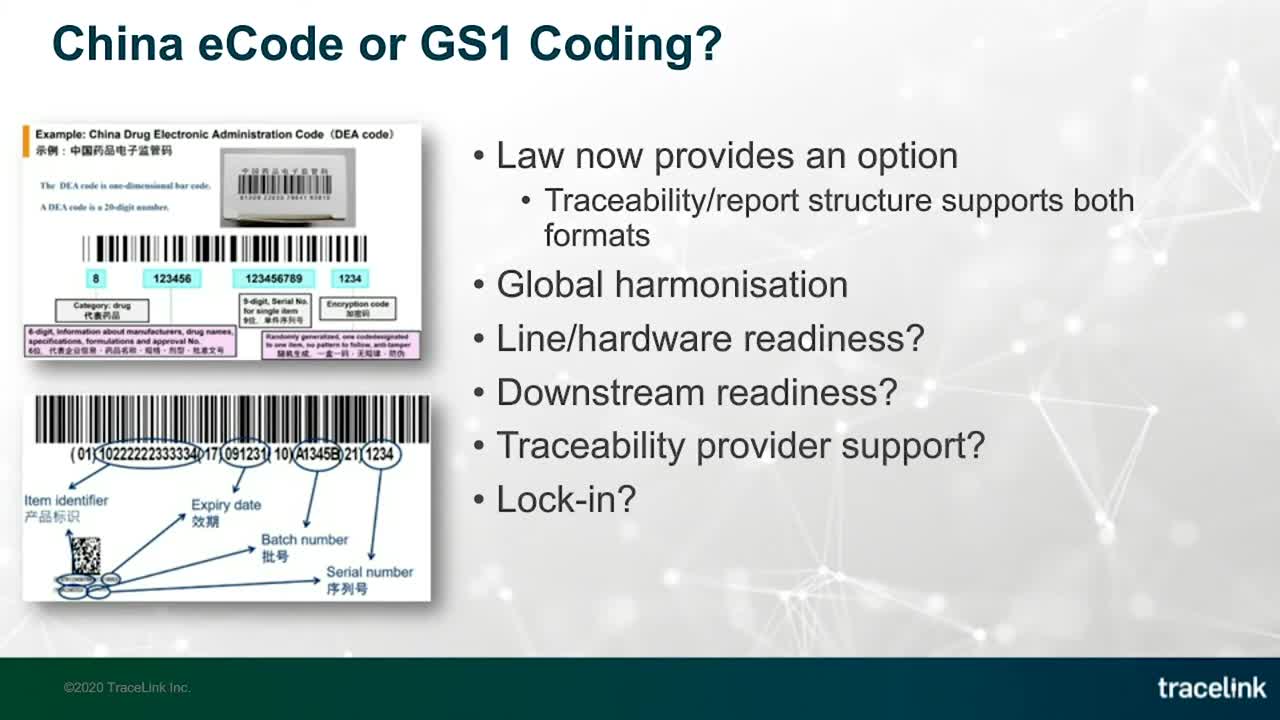
I mentioned before that with the new version of China regulations, the law has provided two options. The traceability report structure does support both formats.
TraceLink supports both formats. We have used the eCode for the previous version of our China solution. Since we have a rather extensive set of solutions for other countries, we handle GS1 standards there as well. I want you to understand what the options are, but also there are some implications there.

Going back to the first version, we had the eCode. That is a 1D or linear barcode that was put on each product. It's proprietary, not aligned with GS1 standards. There was a lot of work between GS1 and industry with China and the NMPA, to allow the GS1 standard. Now, many companies prefer GS1 because of the global harmonization. As I said, manufacturers are using GS1 and other regimes. Many of their lines and hardware are tooled for using GS1. One consideration for China is whether your downstream trade partners—wholesalers, pharmacies, and hospitals—would be able to read the GS1 codes.

In addition, we've learned that at that third tier, where you're selecting your traceability provider, some providers offer support for just one of these coding schemes. You, as a company, need to decide. But you don't need to make one blanket decision. You can make a decision per product on how you want to encode them. I'd say the tier-three selection is tied also to your coding strategy, so just keep that in mind as you're selecting a provider.

Finally, there are some questions as to whether, if you start with one code—let's say for this December deadline—if you would be stuck using it, or if that coding is on a per batch level. We're waiting for some clarification from the NPMA on that. Not all questions on coding have been answered, but I hope to give you at least a flavor and some awareness of the discussion.

Since 2015, China’s track and trace regulations have specified that products be identified using the 20-character Chinese eCode standard. In 2019, the guidelines were amended to include a second encoding option that conforms to the GS1 coding standard used by manufacturers to meet traceability regulations in markets around the world.

Which one is right for you? Watch this short excerpt from our recent webinar, China's Technical Requirements and Compliance Deadlines: What You Need to Know Now, to learn more and to understand key considerations for making the right choices.

<a href="/category/video" hreflang="en">Video</a><a href="/category/china-pharmaceuticals" hreflang="en">China Pharmaceuticals</a><a href="/category/global-compliance" hreflang="en">Global Track & Trace</a><a href="/category/serialization" hreflang="en">Serialization</a><a href="/region-type/china" hreflang="en">China</a>

Table of contents

Learn more about TraceLink's China compliance solution.
Contact Us
Learn more about TraceLink's China compliance solution.
 

Thank you for contacting us; we’ll be in touch shortly.

More China Compliance Resources
china-insights-thumbnail_v01.png
China Reporting and Compliance Systems: Key Considerations
What makes China compliance so challenging? Watch this brief overview of China’s 3-tier reporting system to help guide your China serialization strategy.
View More
china-compliance_infographic_3dcover-350.jpg
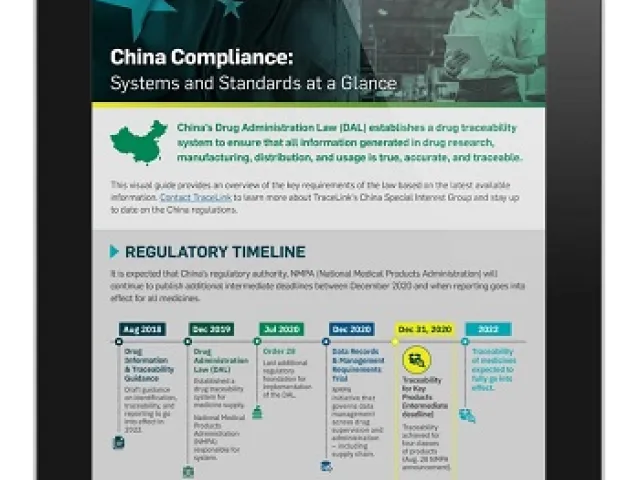
China Compliance: Systems and Standards at a Glance
This infographic provides an overview of the key requirements of China’s track and trace law so you can begin your serialization and compliance planning now
View More
china-insights-thumbnail_v02.png
Are Your Products China Ready? Three Key Decisions for Multinational Pharma Companies
China's drug administration law and serialization framework for medicines could affect your China product packaging strategy. Learn how today.
View More

Cookie Settings

When you visit any website, it may store or retrieve information on your browser, mostly in the form of cookies or similar tracking technologies. Please see below for an overview of the categories of cookies and similar technologies used on this site. You can allow or deny some of all of them, except Strictly Necessary Cookies which are required to provide the site to you. However, blocking some types of cookies may impact your experience of the site and services we are able to offer.

Please see our Cookie Policy for more details, including a list of the cookies we use. You can change your consent options at any time by following the “Cookie Settings” link in the Cookie Policy.
'Strictly Necessary' cookies let you move around the Site and use essential features like secure areas, shopping baskets and online billing. Without these cookies you would not be able to navigate between pages or use certain vital features of our Site, so we do not require your consent for their use. These cookies don't gather any information about you that could be used for marketing or remembering where you've been on the internet. For example, we use these Strictly Necessary cookies to identify you as being logged in to the Site. You can set your browser to block or alert you about these cookies, but if you do so, some parts of the Site will not work.
'Performance' cookies collect information about how you use the Site, such as which pages you visit, the time spent on the Site and if you experience any errors. We use performance cookies to provide aggregated statistics on how the Site is used and help us improve the Site including by measuring any errors that occur.
'Functional' cookies are used to provide services or to remember settings to improve your visit. We use 'Functionality' cookies to remember your settings and choices and show you when you're logged in to the Site.
‘Targeting' cookies are linked to services provided by third parties, such as 'Like' buttons and 'Share' buttons. The third party provides these services in return for recognizing that you have visited the Site. We also use 'Targeting' cookies to gather information that could be used to display content that we think may interest you.
Register for FutureLink Barcelona 2026 Today→
TraceLink — Network for Greater Good
Log In OPUS Platform · TraceLink Classic
AI Mode
Featured Report The Agentic Supply Chain Operating Model →

Agentic Business Processes

External Manufacturing Logistics Transportation Commerce Compliance

Products

Digital Transaction Exchange Process Collaboration Global Track-and-Trace Regulatory Compliance Real-Time Intelligence

Resources

Resource Center TraceLink University Partners Community Customers Events

About TraceLink

Company Overview Newsroom Culture & Careers Open Jobs Legal & Trust Center Corporate Social Responsibility Network Directory Glossary

Hot Topics

Eliminate Stockouts Improve OTIF Reduce Costs Increase End-to-End Visibility Accelerate Order-to-Cash Optimize Inventory Levels Scale Cross-Partner Execution
Need assistance? Contact Technical Support→

Contact Us Today

Transform your supply chain operations with a human-agent workforce.

Contact Us →

Stay Up-to-Date

Subscribe to receive industry insights and evolving trends.

Thanks — you're subscribed.

© TraceLink Inc. 2009–2026 All Rights Reserved