

Table of contents
It is essential to improve communication and collaboration as your suppliers are your best source of advice on how best to mitigate the impact of a global shortage.
Left unresolved, supply chain issues with direct material suppliers can quickly escalate to manufacturing disruptions that impact customer deliveries and revenue. The global integrated circuit (IC) chip shortage is an example of an issue that was left unresolved, and now a component costing a few cents to a few dollars has drastically slowed down the production of vehicles selling for $30,000 or more. One global automobile manufacturer announced that the chip shortage will result in a $1.5B to $2.0B revenue loss in 2021.
While many factors lead to chip shortage, one important lesson learned is global supply chains are increasingly interconnected. Your suppliers are a vital link to the complexities of your upstream supply chain. The automobile manufacturers scaled back production forecasts when the pandemic lockdowns happened, but new auto sales did not fall off at the levels expected. IC chip manufacturers scaled back production, including the wafers at the heart of an IC chip, which have a 26-week lead time. Compounding the issue for the auto manufacturers, demand for home office electronics increased dramatically and high-tech manufacturers increased their orders for IC chips. In the interconnected global supply chain for IC chips, this put high-tech manufacturers at the front of the line for IC chips. In addition, many high-tech manufacturers have learned the hard way that they need to build stronger relationships and improve communication with critical IC chip suppliers to mitigate the disruptions that may impact the availability of products.

Collaborative supply chain issue resolution builds stronger relationships
Given the goal of building stronger relationships, ad hoc supply chain issue resolution processes that are based on phone calls and emails are not sufficient for any issue resolution, let alone the fallout of a global component shortage. It is essential to improve communication and collaboration as your suppliers are your best source of advice on how best to mitigate the impact of a global shortage.
The Incident Management for Direct Suppliers process template found in Agile Process Teams for Supply Chain Issue Management (APT-SCIM) was specifically designed to address these unstructured and inefficient methods of communication, and it dramatically reduces issue resolution time. With APT-SCIM, both you and your supply chain partners can transform the issue management process and use this effort to build the stronger relationship needed to mitigate the impact of supply chain disruptions.
APT-SCIM easily connects you and your partners digitally and securely. Cross-functional subject matter expert teams are formed in this digital environment for you and your partners, where members can create, monitor, and track progress of the resolution of issues with role-based access controls. Enabling supply chain partners to proactively inform you of a current or pending issue is essential to building a stronger relationship and it provides maximum lead time to mitigate potential supply chain disruptions. This includes encouraging suppliers to report even small issues. With many drop-down lists to enable easy and complete incident capture, the Incident Management for Direct Suppliers solution is designed to be used with no training to encourage widespread adoption.
Relating this back to the global chip shortage, if your contract manufacturers reported the first partially filled IC chip orders, whether it had an impact on current production orders or not (they may have buffer stock to mitigate partially filled orders), it would have provided a leading indicator of the developing global shortage. APT-SCIM makes it easy to report issues and see similar issues occurring with other chips used in other products at other contract manufacturers.
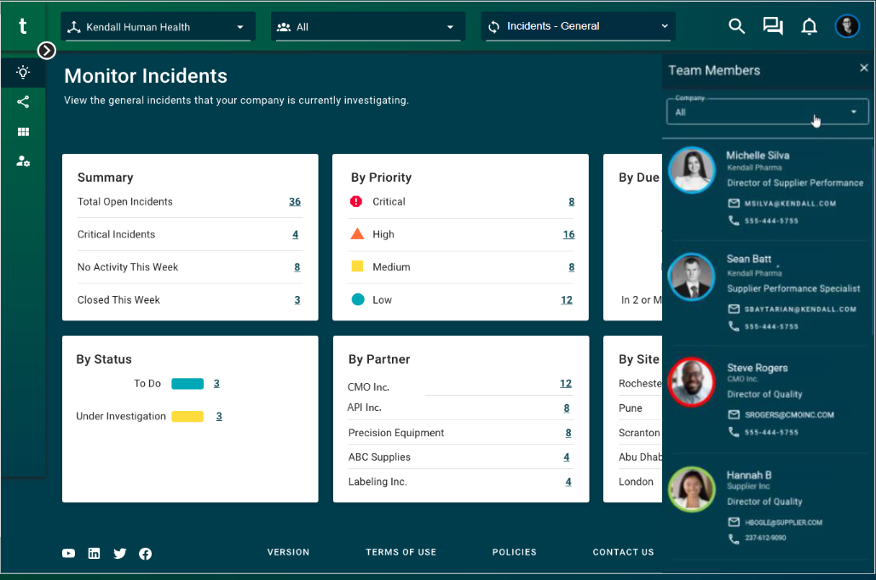
The Monitor Incidents dashboards in the Incident Management for Direct Suppliers process provides critical metrics, enabling you to determine the most important issues quickly by drilling into the details to track ownership, due dates, issue resolution status, and more. In the case of the IC chip shortage, this dashboard would show a growing number of incidents at contract manufacturers, internal factories, or IC chip suppliers (if you are ordering chips directly).
The aggregated view provided by the dashboard would provide insight into the developing IC chip shortage. While you cannot prevent a global shortage, the collaborative resolution process in APT-SCIM would enable you to work with suppliers and internal teams to determine the best approach to mitigate the impact of the shortages. This might include increasing orders for critical components, allocating IC chips to most profitable products, increasing product prices, or cancelling planned product promotions. As I noted above, the best high-tech manufacturers saw the shortage developing and got ahead of it.
The Incident Management for Direct Suppliers process template in Supply Chain Issue Management is purpose-built to streamline incident capture and resolution with direct suppliers. It can be easily customized using TraceLink Solution Builder. For a chronic problem such as the global IC chip shortage that is projected to last for several years, Solution Builder enables business users to customize the Add Incident form to collect more specific data to better support IC chip shortage incident resolution needs. As the global IC chip shortage challenges evolve, Solution Builder makes it easy for business users to continue to customize the Incident Management for Direct Suppliers solution as required.
Direct material suppliers are critical to your ability to meet on-time, in-full and revenue goals. As we have seen with the global IC chip shortage, material shortages of a few tiny components can lead quickly to large revenue shortfalls. Using APT-SCIM to improve collaborative issue capture and resolution can help you build stronger relationships with critical suppliers. Your suppliers will get many of the same workflow efficiency and critical information intelligence benefits you get by using APT-SCIM, and it will cost them nothing to use it. In the end, you can become one of their best customers and share insights to prepare your supply chain for the next global material shortage.
And visit our Supply Chain Issue Management Resource Center.