
Home
  • AI Mode
  • Supply Chain Orchestration
    fast
    Supply Chain Orchestration
    • Life Sciences Company
    • Direct Material Supplier
    • Contract Manufacturer
    • Third Party Logistics
    • Wholesale Distributor
    • Healthcare Provider
    • Retail Pharmacy
  • Network
  • Products
    fast
    Products
    • Multienterprise Information Network Tower (MINT)
    • Process Orchestration for Empowered Teams (POET)
    • Track-and-Trace
  • Resources
    fast
    Resources
    • Resource Center
    • TraceLink University
    • TraceLink Glossary
    • Partners
    • Community
    • Events
    • Customers
  • About
    fast
    About
    • Our Story
    • Newsroom
    • Culture and Careers
    • Leadership
    • Our Values
    • Corporate Social Responsibility
    • Contact Sales
  • Log In
    • Tracelink Classic
      TraceLink Classic app.tracelink.com
      Redirect
    • Opus Platform
      Opus Platform opus.tracelink.com
      Redirect
Log In
  • Tracelink Classic
    TraceLink Classic app.tracelink.com
    Redirect
  • Opus Platform
    Opus Platform opus.tracelink.com
    Redirect
Resources

Breadcrumb

  1. Home
  2. Resources
  3. Resource Center

Improving OTIF: How to Start Building a More Patient-Centric, Agile Supply Chain

banner-image
  • Download PDF
  • Share
    • LinkedIn
    • Facebook
    • Mail
    • Twitter

Table of contents


Key Takeaways

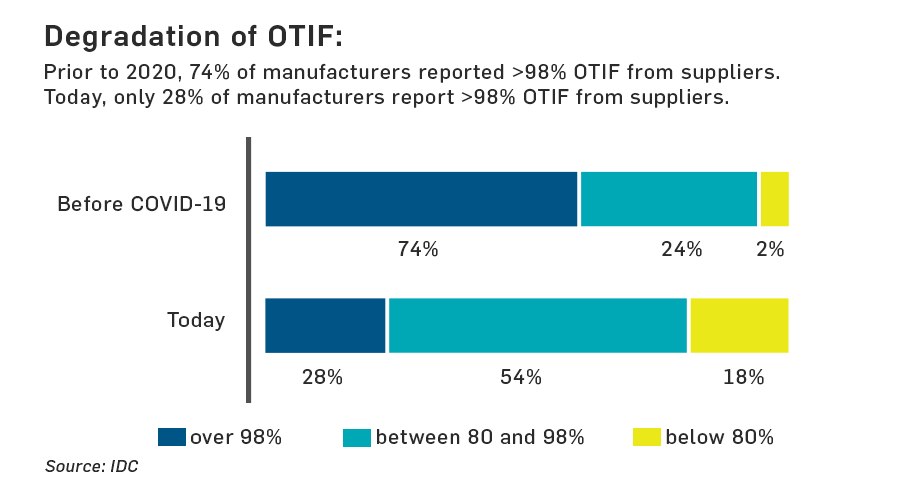
  • Pharmaceutical manufacturers’ on time, in full (OTIF) rates have fallen off dramatically since the beginning of the COVID-19 pandemic, according to IDC.
  • About two-thirds of pharma supply chain companies have lost the ability to effectivity forecast demand.
  • Responses to supply chain disruptions should be timely, resilient, reliable, and compliant.

COVID-19 has taken a major toll on the pharma industry’s ability to get medicines to patients on time and in full—and a lack of patient-centric supply chain strategies may be to blame—according to a new survey report from IDC.

“Prior to 2020, almost three quarters of manufacturers said their on-time, in-full [rate] exceeded 98 percent,” explains IDC Program Vice President and Supply Chain Strategies Practice Leader Simon Ellis, who presents the survey results in a new TraceLink on-demand webinar. “In 2020, it's fallen to 28 percent. That is a massive degradation of performance and we've seen it be quite persistent over the course of 2020.”
IDC Chart

The IDC and TraceLink survey of more than 500 companies across the end-to-end pharma supply chain reveals that some additional challenges created by COVID-19 include increased production and general supply chain costs, a rise in drug shortages, and a degradation of service levels to patients. The survey also finds that:

  • 81% of respondents are reactive and expediting to meet demand.
  • 66% of respondents have lost the ability to forecast demand.
  • 65% of respondents can no longer accurately plan supply.

Taken together, these issues indicate a clear need for companies to adopt outside-in, patient-centric supply chain management strategies and take immediate steps to boost resiliency, according to Ellis and TraceLink Digital Transformation Strategist Roddy Martin, who co-hosts the webinar. Today, only 10% of pharma companies are actively embracing patient-centric approaches.

The path to a patient-centric supply chain
How can companies get started on building a patient-centric, agile supply chain? One approach begins with an honest look at the gaps in an organization’s technology stack, says Martin.

“Start off by looking at your technology model,” he advises. “If you can't share data, if you don't have visibility of product flow, if you don't have secure distribution of your products because you don't have serialization, guess what: You've got a lot of really fundamental, basic problems to solve before you worry about patient-centricity.”

Some of Ellis and Martin’s additional recommendations for achieving patient-centricity include:

  • Deploy agile processes along with an enabling technology that supports end-to-end supply chain collaboration, actionable visibility, and data sharing between partners inside and outside the organization and across all stakeholder functions.

  • Work to ensure holistic responses to disruptions that are timely, resilient, reliable, and compliant. Additionally, do your best to ensure that the responses to disruptions minimize the impact on patient supply.

  • Begin using third-party, multi-enterprise networks to exchange information and collaborate with downstream and upstream trading partners.

  • Use “outside-in” patient dispensing and usage data on a significant scale to gain more visibility into structured segments of downstream demand and improve demand forecast accuracy.

  • Take the necessary steps to ensure that patients get the medicines they need when they need them. This must be the company-wide vision and operating model orchestrated cross-functionally across internal departments and the end-to-end demand and supply network.

“It's got to be the operating model, cross functionally, upstream to suppliers, downstream to customers, thinking about the end-to-end supply network, certainly, but the end-to-end demand network as well,” Ellis says. “Unless you do those kinds of things, you're not patient-centric. You're not patient-driven.”

Want to learn more? Watch our on-demand webinar for more IDC survey results and analysis.

BlogSupply Chain Collaboration, Supply Chain DigitalizationSupply Chain

Table of contents

Subscribe to Agile Supply Chain Insights
Stay informed with the latest patient-centric agile supply chain thought leadership content.
SUBSCRIBE
Subscribe to Agile Supply Chain Insights
Stay informed with the latest patient-centric agile supply chain thought leadership content.
 

Thank you for contacting us; we’ll be in touch shortly.

Cookie Settings

When you visit any website, it may store or retrieve information on your browser, mostly in the form of cookies or similar tracking technologies. Please see below for an overview of the categories of cookies and similar technologies used on this site. You can allow or deny some of all of them, except Strictly Necessary Cookies which are required to provide the site to you. However, blocking some types of cookies may impact your experience of the site and services we are able to offer.

Please see our Cookie Policy for more details, including a list of the cookies we use. You can change your consent options at any time by following the “Cookie Settings” link in the Cookie Policy.
'Strictly Necessary' cookies let you move around the Site and use essential features like secure areas, shopping baskets and online billing. Without these cookies you would not be able to navigate between pages or use certain vital features of our Site, so we do not require your consent for their use. These cookies don't gather any information about you that could be used for marketing or remembering where you've been on the internet. For example, we use these Strictly Necessary cookies to identify you as being logged in to the Site. You can set your browser to block or alert you about these cookies, but if you do so, some parts of the Site will not work.
'Performance' cookies collect information about how you use the Site, such as which pages you visit, the time spent on the Site and if you experience any errors. We use performance cookies to provide aggregated statistics on how the Site is used and help us improve the Site including by measuring any errors that occur.
'Functional' cookies are used to provide services or to remember settings to improve your visit. We use 'Functionality' cookies to remember your settings and choices and show you when you're logged in to the Site.
‘Targeting' cookies are linked to services provided by third parties, such as 'Like' buttons and 'Share' buttons. The third party provides these services in return for recognizing that you have visited the Site. We also use 'Targeting' cookies to gather information that could be used to display content that we think may interest you.

Footer

  • Quick Links
    Get a Demo
    TraceLink Network Directory
    The Network
    OPUS Platform
    Technical Support
    Open Jobs
    API: Terms of Use
  • Products
    Multienterprise Information Network Tower
    U.S. DSCSA Compliance
    Targeted Recalls
    Process Orchestration for Empowered Teams
    Serialization
    Global Compliance
  • Resources
    Resource Center
    Events
    TraceLink University
    Partners
    Community
  • About TraceLink
    Our Story
    Newsroom
    Culture & Careers
    Leadership
    Our Values
    Corporate Social Responsibility
  • Hot Topics
    Transaction Integration
    Supply Chain Visibility
    DSCSA Compliance
    Process Orchestration
    Kazakhstan Compliance for Pharmaceuticals
    Kyrgyzstan Compliance for Pharmaceuticals
Follow Us on Social
Facebook
Linkedin
X
Legal & Trust.
© TraceLink Inc. 2009-2026 All Rights Reserved
Contact Us Today
Contact us today to begin your journey toward agentic supply chain orchestration — digitalize your end-to-end supply chain with intelligence, flexibility, and collaborative orchestration.
Contact Us
Stay Up-to-Date
Subscribe to receive industry insights and stay at the forefront of evolving trends.
Subscribe