

Register for FutureLink Barcelona 2026 Today→
TraceLink — Network for Greater Good
AI Mode Agents AI Solutions Network Resources About
LOG IN TraceLink Classic OPUS Platform
Resources

Breadcrumb

  1. Home
  2. Resources
  3. Resource Center

Survey: Improving Supplier Quality is the Top Priority for Manufacturers

banner-image
  • Download PDF
  • Share
    • LinkedIn
    • Facebook
    • Mail
    • Twitter

Table of contents

Key Takeaways

  • Improving supplier quality is the top priority for 84% of supply chain executives at manufacturing companies. 
  • New types of digital collaboration and communication can empower improvement efforts in this area.

When it comes to direct supplier management, improving the quality of product, processes, and services is a top priority among manufacturing executives in the life sciences space, according to a new survey conducted by Gatepoint Research. However, the methods they currently use to collaborate with supply chain partners may leave opportunities for improvement.

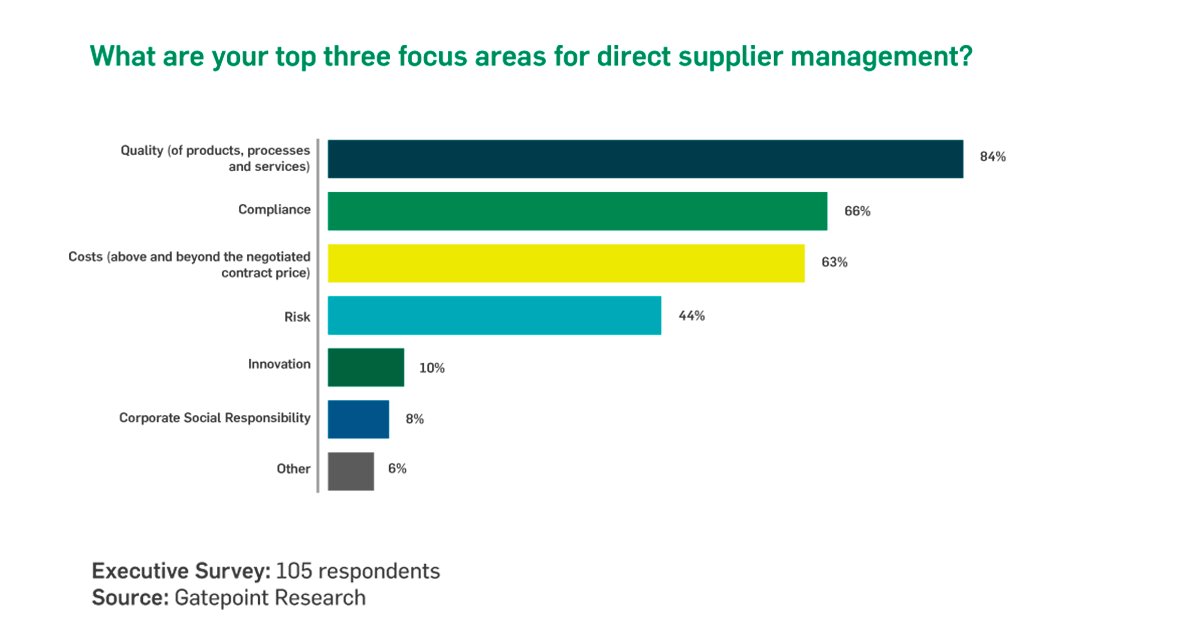
As businesses look to reinvent the way they manage direct suppliers, one focal point of improvement stood out among the rest: quality. A whopping  84% of respondents said their top priority for direct supplier management was improving supplier quality, according to the survey.

Trailing behind, compliance (66%), costs (63%), risk (44%), innovation (10%), and corporate social responsibility (8%) were also cited as priorities. Gatepoint polled more than 100 company leaders—including managers, directors, vice presidents, and C-level executives.
Improving the quality of interactions improves the quality of the supply chain
Direct suppliers are vital strategic partners—their ability to deliver goods and services has a direct impact on a manufacturing organization’s ability to satisfy the needs of customers. Prioritizing the improvement of the systems that manage supplier quality are key to running a successful supply chain.

However, the way many businesses collaborate with their suppliers may not be ideal for driving further optimization of these systems and processes. The majority of interactions between life science companies and their supply chain partners are happening across email (with relevant information shared in attachments), phone calls, and meetings (virtual and in person), according to Gatepoint Research’s survey.

As supply chain networks grow more sophisticated and expand to include more partners, these communication avenues can pose multiple challenges. Some common obstacles include:

  • Lack of visibility and transparency of all supply chain interactions from start to finish
  • Difficulty ensuring the right people are involved when resolving issues
  • Trouble managing communications in a timely and efficient manner

A virtual workspace designed for the realities of Industry 4.0
Digital multienterprise work management solutions can dramatically improve collaboration across the supply chain. By bringing your entire supply chain network together under one roof in a single virtual workspace, you can improve the way you interact with your strategic partners and gain complete alignment across people, processes, and technology.

Agile Process Teams for Supply Chain Issue Management (APT-SCIM) was designed specifically for this type of high-touch, fast-moving environment. With APT-SCIM, supply network teams have the power to:

  • Create digital networks to link internal and external stakeholders
  • Assemble internal and external digital teams across functional boundaries
  • Use prebuilt solution templates to instantly communicate changes to suppliers and customers
  • Customize solutions and extend workflows to build better supply chain relationships
  • Use dashboards to track active incidents, change requests, and document reviews

Collaboration across the supply chain has never been more important. Make sure your organization is equipped to thrive in today’s era of sophisticated supply chain networks that rely on tight coordination between a multitude of different organizations and partners with APT-SCIM. 
Download our new handbook to learn more about the power of multienterprise work management apps like APT-SCIM. 
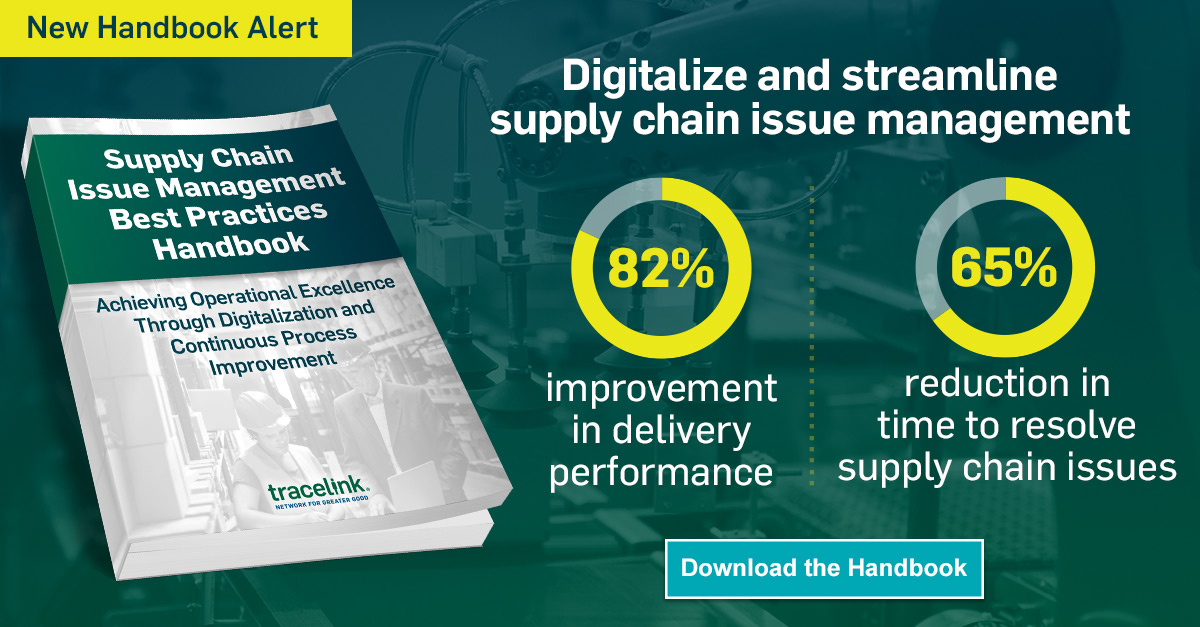
Download our new handbook to learn how multienterprise applications can deliver operational excellence across your supply chain.


<a href="/category/blog" hreflang="en">Blog</a><a href="/category/supply-chain-collaboration" hreflang="en">Supply Chain Collaboration</a><a href="/category/supply-relationship-management" hreflang="en">Supply Relationship Management</a>

Table of contents

Subscribe to Agile Supply Chain Insights
Stay informed with the latest patient-centric agile supply chain thought leadership content.
 

Thank you for contacting us; we’ll be in touch shortly.

Learn more about the power of digital supply networks:
wholesaler-computer-storage-scanner-audit.png
Survey: Late Shipments Top List of Biggest Sources of Supply Chain Risk
Manufacturing executives reveal the top sources of supply chain risk—and what you can do about them. Get the survey results.
View More
updated_supply_plan.png
The Supplier Quality Challenge: Improving Products and Business Processes with Multienterprise Work Management
Ensuring supplier quality is a major challenge for supplier relationship management teams. Learn how multienterprise work management can help.
View More
line-management
The Top Six Supply Chain Issue Management Challenges—and How to Overcome Them
Lengthy issue resolution times top the list of the six biggest challenges to successful supply chain issue management. Get the survey results.
View More
Keep your business running and growing
Inside the Rise of the Digital Supply Network: What Does the Future Hold for Supply Chains?
Explore the evolution of supply chain technology—and see where supplier relationship management is heading in the future.
View More
thoughtleadership_supplychain_shipping_scan.jpg
Poor Visibility Tops IDC’s List of 6 Obstacles to Pharma Supply Chain Resilience
More than half of companies across the end-to-end pharma supply chain lack the upstream and downstream visibility needed to respond effectively to sudden marketplace disruptions, according to new research from market intelligence firm IDC into the impact of COVID-19 on the global pharmaceutical industry.
View More

Cookie Settings

When you visit any website, it may store or retrieve information on your browser, mostly in the form of cookies or similar tracking technologies. Please see below for an overview of the categories of cookies and similar technologies used on this site. You can allow or deny some of all of them, except Strictly Necessary Cookies which are required to provide the site to you. However, blocking some types of cookies may impact your experience of the site and services we are able to offer.

Please see our Cookie Policy for more details, including a list of the cookies we use. You can change your consent options at any time by following the “Cookie Settings” link in the Cookie Policy.
'Strictly Necessary' cookies let you move around the Site and use essential features like secure areas, shopping baskets and online billing. Without these cookies you would not be able to navigate between pages or use certain vital features of our Site, so we do not require your consent for their use. These cookies don't gather any information about you that could be used for marketing or remembering where you've been on the internet. For example, we use these Strictly Necessary cookies to identify you as being logged in to the Site. You can set your browser to block or alert you about these cookies, but if you do so, some parts of the Site will not work.
'Performance' cookies collect information about how you use the Site, such as which pages you visit, the time spent on the Site and if you experience any errors. We use performance cookies to provide aggregated statistics on how the Site is used and help us improve the Site including by measuring any errors that occur.
'Functional' cookies are used to provide services or to remember settings to improve your visit. We use 'Functionality' cookies to remember your settings and choices and show you when you're logged in to the Site.
‘Targeting' cookies are linked to services provided by third parties, such as 'Like' buttons and 'Share' buttons. The third party provides these services in return for recognizing that you have visited the Site. We also use 'Targeting' cookies to gather information that could be used to display content that we think may interest you.
Register for FutureLink Barcelona 2026 Today→
TraceLink — Network for Greater Good
Log In OPUS Platform · TraceLink Classic
AI Mode
Featured Report The Agentic Supply Chain Operating Model →

Agentic Business Processes

External Manufacturing Logistics Transportation Commerce Compliance

Products

Digital Transaction Exchange Process Collaboration Global Track-and-Trace Regulatory Compliance Real-Time Intelligence

Resources

Resource Center TraceLink University Partners Community Customers Events

About TraceLink

Company Overview Newsroom Culture & Careers Open Jobs Legal & Trust Center Corporate Social Responsibility Network Directory Glossary

Hot Topics

Eliminate Stockouts Improve OTIF Reduce Costs Increase End-to-End Visibility Accelerate Order-to-Cash Optimize Inventory Levels Scale Cross-Partner Execution
Need assistance? Contact Technical Support→

Contact Us Today

Transform your supply chain operations with a human-agent workforce.

Contact Us →

Stay Up-to-Date

Subscribe to receive industry insights and evolving trends.

Thanks — you're subscribed.

© TraceLink Inc. 2009–2026 All Rights Reserved