
Home
  • AI Mode
  • Supply Chain Orchestration
    fast
    Supply Chain Orchestration
    • Life Sciences Company
    • Direct Material Supplier
    • Contract Manufacturer
    • Third Party Logistics
    • Wholesale Distributor
    • Healthcare Provider
    • Retail Pharmacy
  • Network
  • Products
    fast
    Products
    • Multienterprise Information Network Tower (MINT)
    • Process Orchestration for Empowered Teams (POET)
    • Track-and-Trace
  • Resources
    fast
    Resources
    • Resource Center
    • TraceLink University
    • Partners
    • Community
    • Events
  • About
    fast
    About
    • Our Story
    • Newsroom
    • Culture and Careers
    • Leadership
    • Our Values
    • Corporate Social Responsibility
    • Contact Sales
  • Log In
    • Tracelink Classic
      TraceLink Classic app.tracelink.com
      Redirect
    • Opus Platform
      Opus Platform opus.tracelink.com
      Redirect
Log In
  • Tracelink Classic
    TraceLink Classic app.tracelink.com
    Redirect
  • Opus Platform
    Opus Platform opus.tracelink.com
    Redirect
Resources

Breadcrumb

  1. Home
  2. Resources
  3. Resource Center

Reducing Supply Chain Risk Through Earlier Notification of Supply Chain Issues

By Jim Campbell, Director of Product Marketing
banner-image
  • Download PDF
  • Share
    • LinkedIn
    • Facebook
    • Mail
    • Twitter

Table of contents

When the COVID-19 pandemic started to seriously disrupt supply chains, the United States Food and Drug Administration (FDA) immediately issued guidance and asked for earlier notification of manufacturing and supply chain issues. In the guidance, the FDA asked for “timely, informative notifications” about manufacturing disruptions to assist in “efforts to prevent or mitigate shortages of products.” 

Enabling all employees and supply chain partners to report incidents as soon as they are identified, and then notifying the proper team members, kickstarts the resolution process and reduces risk simply by closing issues faster.

As demonstrated by the FDA’s request, a simple way to reduce the impact of supply chain disruptions is to start resolving them faster through early notification. Supply chain leaders must ask themselves if they have properly enabled their internal teams and supply chain partners with the required tools to quickly notify the right people about supply chain issues.

How to create earlier notifications of supply chain issues

Most companies lack systems or operate inadequate systems for tracking supply chain issues across internal functions and out through external supply chain partners on an end-to-end basis. Without adequate systems in place, neither employees nor supply chain partners are able to inform the company of supply chain issues in a timely and informative manner. The lack of a Supply Chain Work Management (now POET) system leads to late and slow resolution processes that limit the corrective actions that could mitigate the downstream impact of the issues. 

With Incident Management, a process of TraceLink Supply Chain Work Management (now POET), companies can equip their internal teams and supply chain partners with a structured solution to report issues accurately with the click of a button. A simple description is enough to inform the right team members about a critical issue. For a more complete description of the issue, easy-to-use drop-down lists guide the user through the most important information associated with the issue. Companies can customize their own data fields and workflows to match their unique issue management requirements using OPUS Solution Designer, a low-code/no-code solution that enables business analysts to quickly configure and customize experiences for efficient issue management. 
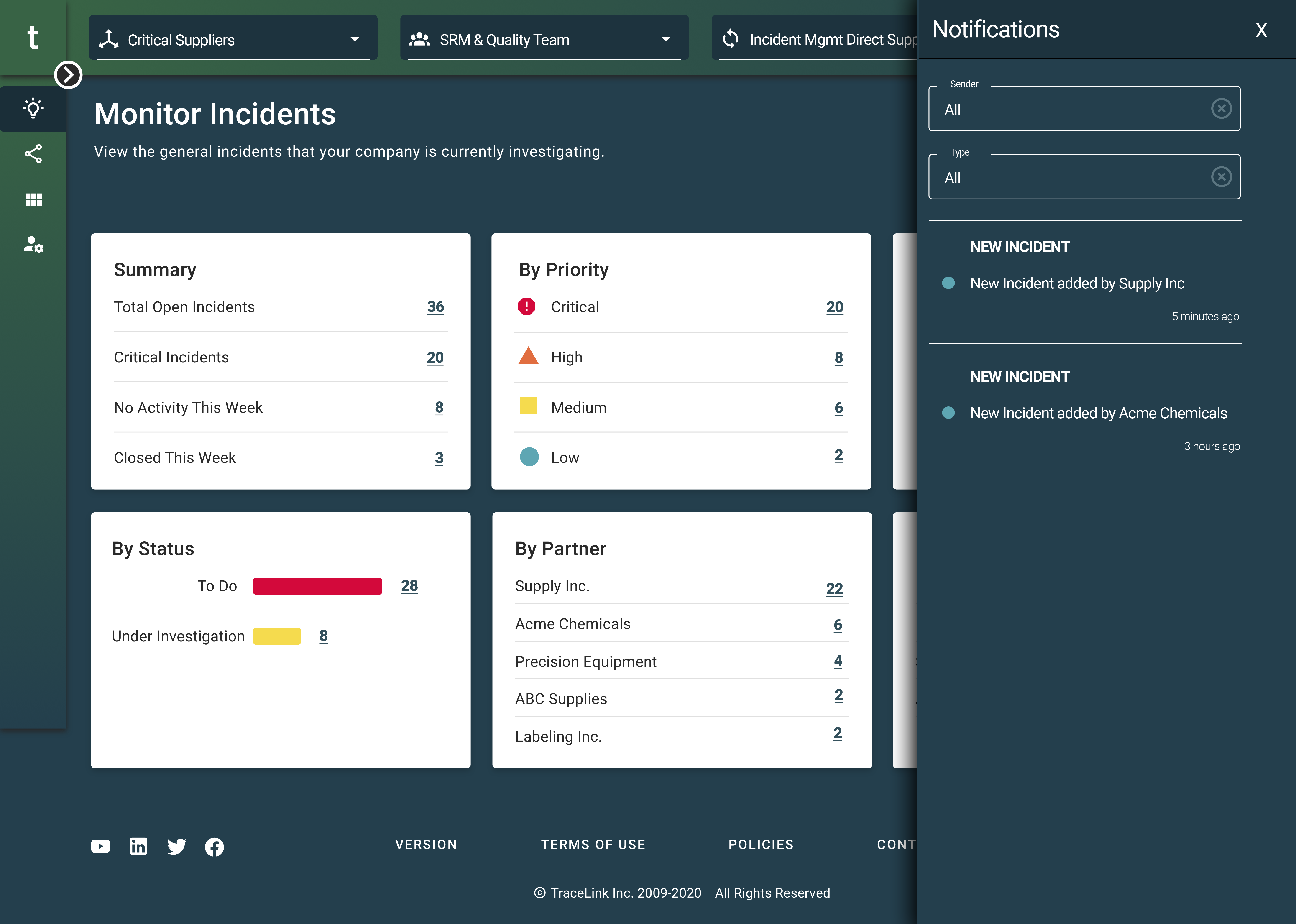
Supply Chain Work Management (now POET) brings speed, structure, visibility, and greater operating efficiency to issue management processes. After the issue has been added, the right team members in the right departments are notified of the open issue. 

For example, a manufacturer can add a material shortage issue, provide all of the details of the issue, and assign the issue to the right person in customer service at the supplier responsible for the shortage. The customer service representative at the supplier will be notified of the issue immediately and begin working on the resolution in a way that is transparent to all team members involved. Relevant team members can collaborate and follow the issue, receiving notifications as the issue is updated. The manufacturer and supplier will document their progress and collaborate in Supply Chain Work Management (now POET) until the issue is resolved. 

Enabling all employees and supply chain partners to report incidents as soon as they are identified, and then notifying the proper team members, kickstarts the resolution process and reduces risk simply by closing issues faster. Supply chain leaders who have enabled earlier notification of supply chain issues with Supply Chain Work Management (now POET) have achieved up to 65% faster resolution time of issues across their organization as well as reduced overall incidents by as much as 35%, among other incredible performance improvements. 

Just as the FDA asked for early reporting of issues to mitigate supply chain disruptions caused by the pandemic, supply chain leaders should be enabling their internal and external teams with digitalized Incident Management processes. Reducing risk in the supply chain starts with knowing about threats as soon as they occur. 

Download our handbook for more on Supply Chain Work Management (now POET) best practices.

Learn more in our Supply Chain Work Management (now POET) Resource Center. 

BlogProcess Orchestration for Empowered Teams (POET)Supply Chain CollaborationSupply Chain

Table of contents

Download the Supply Chain Work Management (now POET) Best Practices Handbook!
Fill out the form to download the eBook now.
 

Thank you. Check your email for a copy of the content you requested.

Cookie Settings

When you visit any website, it may store or retrieve information on your browser, mostly in the form of cookies or similar tracking technologies. Please see below for an overview of the categories of cookies and similar technologies used on this site. You can allow or deny some of all of them, except Strictly Necessary Cookies which are required to provide the site to you. However, blocking some types of cookies may impact your experience of the site and services we are able to offer.

Please see our Cookie Policy for more details, including a list of the cookies we use. You can change your consent options at any time by following the “Cookie Settings” link in the Cookie Policy.
'Strictly Necessary' cookies let you move around the Site and use essential features like secure areas, shopping baskets and online billing. Without these cookies you would not be able to navigate between pages or use certain vital features of our Site, so we do not require your consent for their use. These cookies don't gather any information about you that could be used for marketing or remembering where you've been on the internet. For example, we use these Strictly Necessary cookies to identify you as being logged in to the Site. You can set your browser to block or alert you about these cookies, but if you do so, some parts of the Site will not work.
'Performance' cookies collect information about how you use the Site, such as which pages you visit, the time spent on the Site and if you experience any errors. We use performance cookies to provide aggregated statistics on how the Site is used and help us improve the Site including by measuring any errors that occur.
'Functional' cookies are used to provide services or to remember settings to improve your visit. We use 'Functionality' cookies to remember your settings and choices and show you when you're logged in to the Site.
‘Targeting' cookies are linked to services provided by third parties, such as 'Like' buttons and 'Share' buttons. The third party provides these services in return for recognizing that you have visited the Site. We also use 'Targeting' cookies to gather information that could be used to display content that we think may interest you.

Footer

  • Quick Links
    Get a Demo
    TraceLink Network Directory
    The Network
    OPUS Platform
    Technical Support
    Open Jobs
    API: Terms of Use
  • Products
    Multienterprise Information Network Tower
    U.S. DSCSA Compliance
    Targeted Recalls
    Process Orchestration for Empowered Teams
    Serialization
    Global Compliance
  • Resources
    Resource Center
    Events
    TraceLink University
    Partners
    Community
  • About TraceLink
    Our Story
    Newsroom
    Culture & Careers
    Leadership
    Our Values
    Corporate Social Responsibility
  • Hot Topics
    Transaction Integration
    Supply Chain Visibility
    DSCSA Compliance
    Process Orchestration
    Kazakhstan Compliance for Pharmaceuticals
    Kyrgyzstan Compliance for Pharmaceuticals
Follow Us on Social
Facebook
Linkedin
X
Legal & Trust.
© TraceLink Inc. 2009-2026 All Rights Reserved
Contact Us Today
Contact us today to begin your journey toward agentic supply chain orchestration — digitalize your end-to-end supply chain with intelligence, flexibility, and collaborative orchestration.
Contact Us
Stay Up-to-Date
Subscribe to receive industry insights and stay at the forefront of evolving trends.
Subscribe