

Table of contents
Many managers often express disappointment after a product launch has been delayed: ‘If only I had known where the issue resolution process was stuck, I could have deployed more resources.
Outsourced manufacturing has distinct advantages but comes with significant management challenges. On the positive side, capital expenditures for plants and equipment are greatly reduced and you are working with contract manufacturers who have developed highly specialized manufacturing skill sets. The challenges, however, can be daunting because you must work through third-party employees to get a new product launched, address first piece issues, compensate for delays in communication, and adjust to the lack of flexibility to change production schedules. For even the best contract manufacturers, there is a need to stay on top of supply chain issues including material shortages, capacity constraints, forecast changes, low production yields, and poor manufacturability.
To better understand these challenges, let’s use a new product launch as an example. Assuming you already have a relationship with a contract manufacturer capable of producing the new product, there are still a large number of decisions and processes that need to be executed before the first piece comes off the production line. And there will be a continuous stream of issues that need to be resolved by cross-functional teams that include R&D, manufacturing engineering, procurement, quality assurance, supply chain, and planning. There will be a similar team at your contract manufacturer that needs to collaborate with your team to keep the product launch on schedule.

Unfortunately, working across organizational boundaries is not easy, even with the best partners. Most companies rely on emails, phone calls and video meetings to resolve supply chain issues. Keeping a product launch on target will likely lead to daily “stand ups'' with ad hoc processes to follow up on the issues discussed. Limited to spreadsheets and shared folders to track issues, managers have no visibility to the resolution process. Lack of visibility can extend issue resolution time by days, weeks, or months. Many managers often lament after a product launch has been delayed: “If only I had known where the issue resolution process was stuck, I could have deployed more resources.” With a product launch, a long delay can be the difference between first to market and a huge revenue windfall, or a distant second place and the loss of millions in revenue. The good news is that there is a solution to this challenge!
The Incident Management for External Manufacturing process template found in Agile Process Teams for Supply Chain Issue Management (APT-SCIM) was specifically designed to address these unstructured and inefficient methods of communication and dramatically reduces issue resolution time. With APT-SCIM, you and your contract manufacturer can transform the issue management process and ensure the alignment of the product launch teams from both sides of the partnership. APT-SCIM easily connects you and your contract manufacturers digitally and securely. Cross-functional product launch teams are formed for you and your partners within this digital environment, where members can create, monitor, and track the progress of the resolution of issues using role-based access controls.
Enabling product launch team members to proactively log an issue as soon as someone is aware of it ensures that the resolution process can begin immediately. This includes encouraging the team at the contract manufacturer to report even small issues. With many drop-down lists to enable easy and complete incident capture, the Incident Management for External Manufacturing process is designed to be used with no training to encourage widespread adoption, making it feasible to ask occasional users at supply chain partners to log issues.
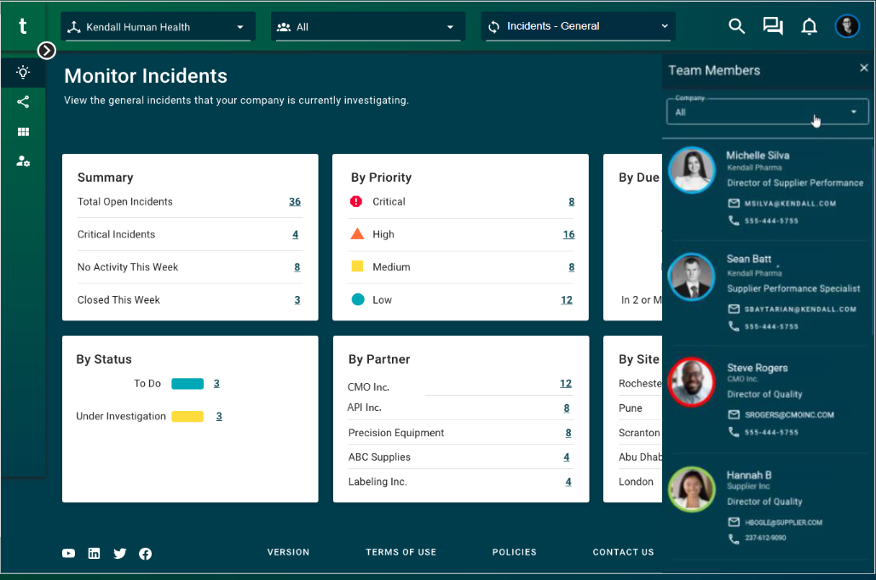
Until the manufacturing process is established and matured, new products have thousands of points of failure including design problems, component failures, poor manufacturability and much more. The Monitor Incidents dashboard in the Incident Management for External Manufacturing process template provides critical metrics enabling you to determine the most important issues quickly by drilling into the details to track ownership, due dates, issue resolution status, and more. The real-time visibility provided by the dashboards enables managers to spot issues that have not been assigned, issues that are falling behind, and which member has the next step in the resolution process.
The Incident Management for External process is purpose-built to streamline incident capture and resolution with contract manufacturers. It can be easily customized using TraceLink Solution Builder. For a new product launch, Solution Builder can enable business users to customize the Add Incident form to collect more specific data to better support new product launch incident resolution needs. As there are likely many suppliers and other supply chain partners in addition to the contract manufacturer that need to be coordinated to ensure a successful product launch, Solution Builder also enables you to create a unique Solution bundle and deploy it over a unique ecosystem network created to group the suppliers involved in the new product launch. Called a “process network,” this group of partners is then managed through a single APT-SCIM dashboard. This enables managers to quickly spot incidents that are languishing and follow up as needed.
If your manufacturing is outsourced, your contract manufacturers are critical to new product launch and ongoing production of your existing products. Resolving any issues that might delay production is critical to your ability to meet on-time, in-full and revenue goals. As noted above, missing a product launch date can dramatically impact lifetime product revenue. Using APT-SCIM to improve collaborative issue capture and resolution can help you build stronger relationships with contract manufacturers. Your contract manufacturers will get many of the same benefits you get by using APT-SCIM and it will cost them nothing to use it. In the end, you can become one of their best customers and share the insights needed to execute product launches ahead of schedule.
Learn more in our Supply Chain Issue Management Resource Center.