
Register for FutureLink Barcelona 2026 Today→
TraceLink — Network for Greater Good
AI Mode Agents AI Solutions Network Resources About
LOG IN TraceLink Classic OPUS Platform
Resources

Breadcrumb

  1. Home
  2. Resources
  3. Resource Center

Engage Cross-Functional Teams to Resolve Supply Chain Issues Faster and Completely

By Mike Juron, Digital Strategy Specialist
banner-image
  • Download PDF
  • Share
    • LinkedIn
    • Facebook
    • Mail
    • Twitter

Table of contents

Agile Process Team for Supply Chain Issue Management (APT-SCIM) provides a structured process and enables internal and external teams to work together in a single application using the same data.

Supply chain issues can originate from a wide variety of internal and external sources. That is why the ability to easily collaborate across internal and external cross-functional subject matter experts is a key requirement for success. For many companies, however, this is challenging because resources are quickly pulled together when needed and teams tend to rely heavily on emails and video calls for communication and data collection.

Email forwarding and CC’s are the primary way to find the right subject matter experts needed to resolve an issue properly. Supply chain partners rely on emails sent to their “point of contact,” often a procurement category manager, not the subject matter expert that needs to be part of the resolution process. As a result of these ad hoc approaches, issues can take weeks to resolve, exacerbating the disruptions associated with delays in resolution.
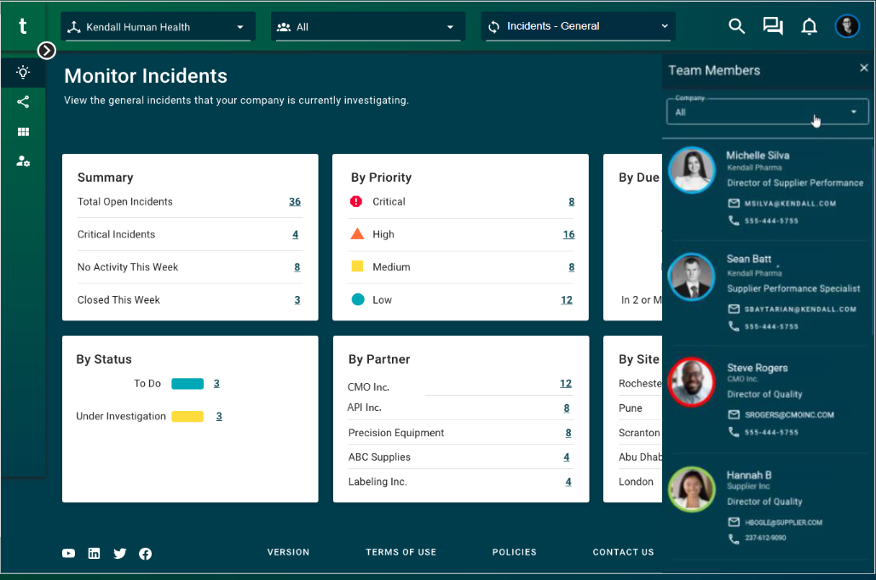
 

When supply chain issues occur, it is important to have a structured process and solution to engage the right internal and external resources immediately. Agile Process Teams for  Supply Chain Issue Management (APT-SCIM) provides out-of-the-box structured supply chain processes and enables internal and external teams to work together in a single application using the same data. With APT-SCIM, you can define process teams that are composed of internal and external subject matter experts. You can create as many process teams as needed to bring the right skill sets to different types of issues or supply chain partners. Dashboards can be filtered by process teams to make it easy for each team to keep track of their open issues and immediately identify any issues that have been assigned high or critical priority. APT-SCIM provides both internal and external team members with:

  • Assignment notifications when action is required
  • Real-time visibility into who is responsible for the next step in the resolution process
  • Clear understanding of issue status
  • Due dates and alerts when issues are past due
  • Historical record of issue resolution steps to aid in continuous improvement efforts

Let’s use a material shortage issue as an example. A material shortage will impact your ability to manufacture a product. Left unresolved, it could shut down a production line and lead to missed shipments and lost revenue. You will need to work with your supplier to understand the magnitude of the shortage and when it will be resolved. Depending on the answer from the supplier, you may need to engage the planner to determine the impact on manufacturing, possibly change production schedules, and engage the commercial team to determine the impact on customers. For a severe shortage, you may need to engage procurement to source from an alternate supplier or onboard a new supplier. In this example, you would have likely engaged with 4-5 functional departments in your company and at your supply chain partners’ companies to resolve the issue.

Today, at most companies, this issue would be addressed with an ad hoc process based on emails and phone calls with no structure. Resolving the issue typically involves daily status meetings, sporadic updates, and lost time determining the status of an issue and finding the right internal and external subject matter experts. On average, this results in resolution processes that take 3-5 or more weeks to complete, and it will likely impact your ability to deliver products on time and in full.

TraceLink’s APT-SCIM solution enables you to establish a process team composed of employees from planning, manufacturing, procurement, and supply chain with their counterparts externally at the supplier or other partners. As the issue resolution process progresses, it might be decided by planning, manufacturing, and the supplier that the shortage will be filled soon enough and will have no impact after some minor rescheduling. If a material shortage is determined to be a long-term problem, procurement can easily be engaged and tasked with finding an alternate source.

APT-SCIM’s real-time dashboards ensure that everyone has visibility into the resolution process, and managers can quickly assign more resources if necessary. In practice, using the process team approach, companies have been able to reduce resolution time by as much as 65%.

Learn more: Download our supply chain issue management best practices handbook today.

Learn more in our Supply Chain Issue Management Resource Center. 

<a href="/category/blog" hreflang="en">Blog</a><a href="/category/supply-chain-collaboration" hreflang="en">Supply Chain Collaboration</a><a href="/category/supply-chain" hreflang="en">Supply Chain</a>

Table of contents

Download the Supply Chain Issue Management Best Practices Handbook!
Fill out the form to download the eBook now.
 

Thank you. Check your email for a copy of the content you requested.

Related Content
line-management
How a Major Manufacturer Improved Delivery Performance by 82% and Avoided $100M in Annual Cost
A major manufacturer embarked on a critical operational excellence initiative to manage the quality and operational performance of its suppliers, with the aim of ensuring reliable delivery of goods and services from highly capable suppliers—without interruption.
View More
Supply Chain Issue Management
Virtual Teams of Subject Matter Experts Eliminate Confusion in Supply Chain Issue Resolution
Agile Process Teams for Supply Chain Issue Management (APT-SCIM) enables you to digitally and dynamically create process teams on demand within an easy-to-use web or mobile interface.
View More
Supply Chain Issue Management
Top 5 Problems Impacting Supply Chain Issue Resolution Processes
While supply chain teams make their best efforts to resolve issues as quickly as possible, they have not had a digital system designed specifically to facilitate structured collaboration and work management between internal teams and supply chain partners—until now.
View More

Cookie Settings

When you visit any website, it may store or retrieve information on your browser, mostly in the form of cookies or similar tracking technologies. Please see below for an overview of the categories of cookies and similar technologies used on this site. You can allow or deny some of all of them, except Strictly Necessary Cookies which are required to provide the site to you. However, blocking some types of cookies may impact your experience of the site and services we are able to offer.

Please see our Cookie Policy for more details, including a list of the cookies we use. You can change your consent options at any time by following the “Cookie Settings” link in the Cookie Policy.
'Strictly Necessary' cookies let you move around the Site and use essential features like secure areas, shopping baskets and online billing. Without these cookies you would not be able to navigate between pages or use certain vital features of our Site, so we do not require your consent for their use. These cookies don't gather any information about you that could be used for marketing or remembering where you've been on the internet. For example, we use these Strictly Necessary cookies to identify you as being logged in to the Site. You can set your browser to block or alert you about these cookies, but if you do so, some parts of the Site will not work.
'Performance' cookies collect information about how you use the Site, such as which pages you visit, the time spent on the Site and if you experience any errors. We use performance cookies to provide aggregated statistics on how the Site is used and help us improve the Site including by measuring any errors that occur.
'Functional' cookies are used to provide services or to remember settings to improve your visit. We use 'Functionality' cookies to remember your settings and choices and show you when you're logged in to the Site.
‘Targeting' cookies are linked to services provided by third parties, such as 'Like' buttons and 'Share' buttons. The third party provides these services in return for recognizing that you have visited the Site. We also use 'Targeting' cookies to gather information that could be used to display content that we think may interest you.
Register for FutureLink Barcelona 2026 Today→
TraceLink — Network for Greater Good
Log In OPUS Platform · TraceLink Classic
AI Mode
Featured Report The Agentic Supply Chain Operating Model →

Agentic Business Processes

External Manufacturing Logistics Transportation Commerce Compliance

Products

Digital Transaction Exchange Process Collaboration Global Track-and-Trace Regulatory Compliance Real-Time Intelligence

Resources

Resource Center TraceLink University Partners Community Customers Events

About TraceLink

Company Overview Newsroom Culture & Careers Open Jobs Legal & Trust Center Corporate Social Responsibility Network Directory Glossary

Hot Topics

Eliminate Stockouts Improve OTIF Reduce Costs Increase End-to-End Visibility Accelerate Order-to-Cash Optimize Inventory Levels Scale Cross-Partner Execution
Need assistance? Contact Technical Support→

Contact Us Today

Transform your supply chain operations with a human-agent workforce.

Contact Us →

Stay Up-to-Date

Subscribe to receive industry insights and evolving trends.

Thanks — you're subscribed.

© TraceLink Inc. 2009–2026 All Rights Reserved