
Register for FutureLink Barcelona 2026 Today→
TraceLink — Network for Greater Good
AI Mode Agents AI Solutions Network Resources About
LOG IN TraceLink Classic OPUS Platform
Resources

Breadcrumb

  1. Home
  2. Resources
  3. Resource Center

Top 5 Problems Impacting Supply Chain Issue Resolution Processes

banner-image
  • Download PDF
  • Share
    • LinkedIn
    • Facebook
    • Mail
    • Twitter

Table of contents

Key Takeaways
  • Reliance on ad hoc processes combined with the lack of shared systems translates into lengthy resolution times for daily supply chain issues that occur across internal sites and external supply chain partners.
  • TraceLink Supply Chain Work Management (now POET) application provides a network-based, multienteprise Supply Chain Work Management (now POET) solution that results in a faster, more strategic approach to issue resolution.
By Nicholas Gasse

While supply chain teams make their best efforts to resolve issues as quickly as possible, they have not had a digital system designed specifically to facilitate structured collaboration and work management between internal teams and supply chain partners—until now.

Any issue—regardless of how small it is or whether it’s a product or business process defect—can paralyze a supply chain. Lengthy issue resolution processes can put your supply chain at risk. Working with internal teams and supply chain partners to resolve an issue can take five to six weeks or longer. During this period, shipment delays, material shortages, out-of-spec products, and other business process and product quality defects can quickly escalate into supply chain disruptions that lead to late deliveries to customers. 
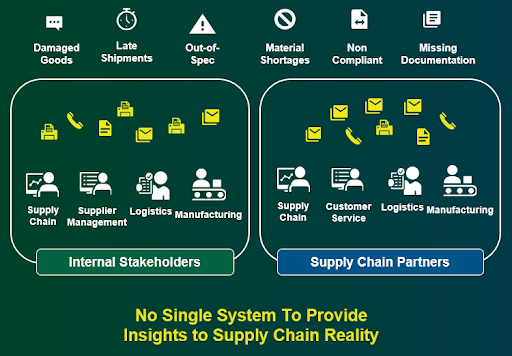
 

The reliance on ad hoc processes and the lack of shared systems is at the root of the lengthy resolution times. Resolving supply chain issues through a web of emails, meetings, and spreadsheets slows the entire process and puts critical information at risk of going unrecorded, jeopardizing your supply chain operations. Here are five major reasons why the current approach is so ineffective:

  1. Poor visibility. Most supply chain management teams lack a comprehensive view of all incidents across the organization, the status of their resolution processes, and their potential impact. As a result, there is no visibility into potential disruptions created as these issues go unresolved.
  2. No institutional memory to support future improvement. Manufacturing companies often lack a recorded institutional memory of learnings from past incidents and resolution patterns that can support root cause analysis and continuous process improvement. Supply chain teams instead send and receive incident reports via email and spreadsheets that do not keep a historical record of resolutions to similar problems..
  3. No incident prioritization or structured resolution process. Supply chain managers often spend between 50-80% of their day in meetings simply learning about incidents, which means they have less time to set strategic priorities and develop intelligent solutions to problems.
  4. Failure to get the right people involved. It’s not always clear which stakeholders should be part of cross-functional and cross-enterprise teams formed to resolve an issue. This lack of clear accountability leads to confusion over roles, responsibilities, and response methodologies.
  5. Unstructured collaboration and siloed information. Cross-functional and cross-enterprise teams have no alternative but to rely on disparate and unstructured communication tools like email, phone calls, and meetings to resolve issues. As a result, vital information often gets lost and deadlines are missed. 

While supply chain teams make their best efforts to resolve issues as quickly as possible, they have not had a digital system designed specifically to facilitate structured collaboration and work management between internal teams and supply chain partners—until now.

A better way with multienteprise Supply Chain Work Management (now POET) software

TraceLink Supply Chain Work Management (now POET)  is a workflow-driven collaboration solution for capturing, analyzing, resolving, correcting, and preventing supply chain issues. This purpose-built solution empowers supply chain operations at every level by:

  • Giving line-level employees tools to quickly report issues like material shortages and quality deviations in a single cloud-based solution shared with supply chain partners.
  • Providing middle management team members with visibility into all issues that are occurring by frequency.
  • Supplying executive leaders with real-time summary data for better strategic decision-making regarding supply chain risks and opportunities. 

TraceLink Supply Chain Work Management (now POET) is a better way to resolve supply chain issues. 

Download our Supply Chain Work Management (now POET) best practices handbook to learn more.

Learn more in our Supply Chain Work Management (now POET) Resource Center. 

<a href="/category/blog" hreflang="en">Blog</a><a href="/category/process-orchestration-empowered-teams-poet" hreflang="en">Process Orchestration for Empowered Teams (POET)</a><a href="/category/supply-chain-collaboration" hreflang="en">Supply Chain Collaboration</a><a href="/category/supply-chain" hreflang="en">Supply Chain</a>

Table of contents

Download the Supply Chain Work Management (now POET) Best Practices Handbook!
Fill out the form to download the eBook now.
 

Thank you. Check your email for a copy of the content you requested.

Related Content
Supply Chain Issue Management
Three Essential Capabilities That Prevent Supply Chain Issues From Escalating into Supply Chain Disruptions
Companies that have digitalized supply chain issue management have seen significant supply chain performance improvements.
View More
Supply Chain Issue Management
The Six Key Capabilities Required to Enable Faster Supply Chain Issue Resolution
“In God we trust, all others must bring data.” W. Edwards Deming, the well-known thought-leader in the field of continuous process improvement, is attributed with this famous statement about the necessity of using an analytical, data-driven approach for making decisions.
View More
Supply Chain Issue Management
Virtual Teams of Subject Matter Experts Eliminate Confusion in Supply Chain Issue Resolution
Agile Process Teams for Supply Chain Issue Management (APT-SCIM) enables you to digitally and dynamically create process teams on demand within an easy-to-use web or mobile interface.
View More

Cookie Settings

When you visit any website, it may store or retrieve information on your browser, mostly in the form of cookies or similar tracking technologies. Please see below for an overview of the categories of cookies and similar technologies used on this site. You can allow or deny some of all of them, except Strictly Necessary Cookies which are required to provide the site to you. However, blocking some types of cookies may impact your experience of the site and services we are able to offer.

Please see our Cookie Policy for more details, including a list of the cookies we use. You can change your consent options at any time by following the “Cookie Settings” link in the Cookie Policy.
'Strictly Necessary' cookies let you move around the Site and use essential features like secure areas, shopping baskets and online billing. Without these cookies you would not be able to navigate between pages or use certain vital features of our Site, so we do not require your consent for their use. These cookies don't gather any information about you that could be used for marketing or remembering where you've been on the internet. For example, we use these Strictly Necessary cookies to identify you as being logged in to the Site. You can set your browser to block or alert you about these cookies, but if you do so, some parts of the Site will not work.
'Performance' cookies collect information about how you use the Site, such as which pages you visit, the time spent on the Site and if you experience any errors. We use performance cookies to provide aggregated statistics on how the Site is used and help us improve the Site including by measuring any errors that occur.
'Functional' cookies are used to provide services or to remember settings to improve your visit. We use 'Functionality' cookies to remember your settings and choices and show you when you're logged in to the Site.
‘Targeting' cookies are linked to services provided by third parties, such as 'Like' buttons and 'Share' buttons. The third party provides these services in return for recognizing that you have visited the Site. We also use 'Targeting' cookies to gather information that could be used to display content that we think may interest you.
Register for FutureLink Barcelona 2026 Today→
TraceLink — Network for Greater Good
Log In OPUS Platform · TraceLink Classic
AI Mode
Featured Report The Agentic Supply Chain Operating Model →

Agentic Business Processes

External Manufacturing Logistics Transportation Commerce Compliance

Products

Digital Transaction Exchange Process Collaboration Global Track-and-Trace Regulatory Compliance Real-Time Intelligence

Resources

Resource Center TraceLink University Partners Community Customers Events

About TraceLink

Company Overview Newsroom Culture & Careers Open Jobs Legal & Trust Center Corporate Social Responsibility Network Directory Glossary

Hot Topics

Eliminate Stockouts Improve OTIF Reduce Costs Increase End-to-End Visibility Accelerate Order-to-Cash Optimize Inventory Levels Scale Cross-Partner Execution
Need assistance? Contact Technical Support→

Contact Us Today

Transform your supply chain operations with a human-agent workforce.

Contact Us →

Stay Up-to-Date

Subscribe to receive industry insights and evolving trends.

Thanks — you're subscribed.

© TraceLink Inc. 2009–2026 All Rights Reserved