
Home
  • AI Mode
  • Supply Chain Orchestration
    fast
    Supply Chain Orchestration
    • Life Sciences Company
    • Direct Material Supplier
    • Contract Manufacturer
    • Third Party Logistics
    • Wholesale Distributor
    • Healthcare Provider
    • Retail Pharmacy
  • Network
  • Products
    fast
    Products
    • Multienterprise Information Network Tower (MINT)
    • Process Orchestration for Empowered Teams (POET)
    • Track-and-Trace
  • Resources
    fast
    Resources
    • Resource Center
    • TraceLink University
    • TraceLink Glossary
    • Partners
    • Community
    • Events
    • Customers
  • About
    fast
    About
    • Our Story
    • Newsroom
    • Culture and Careers
    • Leadership
    • Our Values
    • Corporate Social Responsibility
    • Contact Sales
  • Log In
    • Tracelink Classic
      TraceLink Classic app.tracelink.com
      Redirect
    • Opus Platform
      Opus Platform opus.tracelink.com
      Redirect
Log In
  • Tracelink Classic
    TraceLink Classic app.tracelink.com
    Redirect
  • Opus Platform
    Opus Platform opus.tracelink.com
    Redirect
Tracelink University

Breadcrumb

  1. Home
  2. Resources
  3. TraceLink University

Get Started Designing on the OPUS Platform With OPUS Anthem

The OPUS Platform's Design Guidelines and Conventions
banner-image
  • Download PDF
  • Share
    • LinkedIn
    • Facebook
    • Mail
    • Twitter

Table of contents

Before You Begin

To effectively address your complex business challenges, it is essential to grasp the core principles and fundamentals of both the TraceLink Network and the OPUS Platform. The fusing of a no-code platform with the world's largest supply chain network will empower you to confidently design and implement supply chain solutions specific to you and the needs of your trade partners.

  • OPUS No-Code Fundamentals – Understand how our no-code platform enables you to rapidly create complex supply chain solutions without technical overhead and costly resources. Our platform provides secure, flexible, scalable, and easy-to-use capabilities that empower you to get robust solutions delivered on time and in full.

Anthem Design System
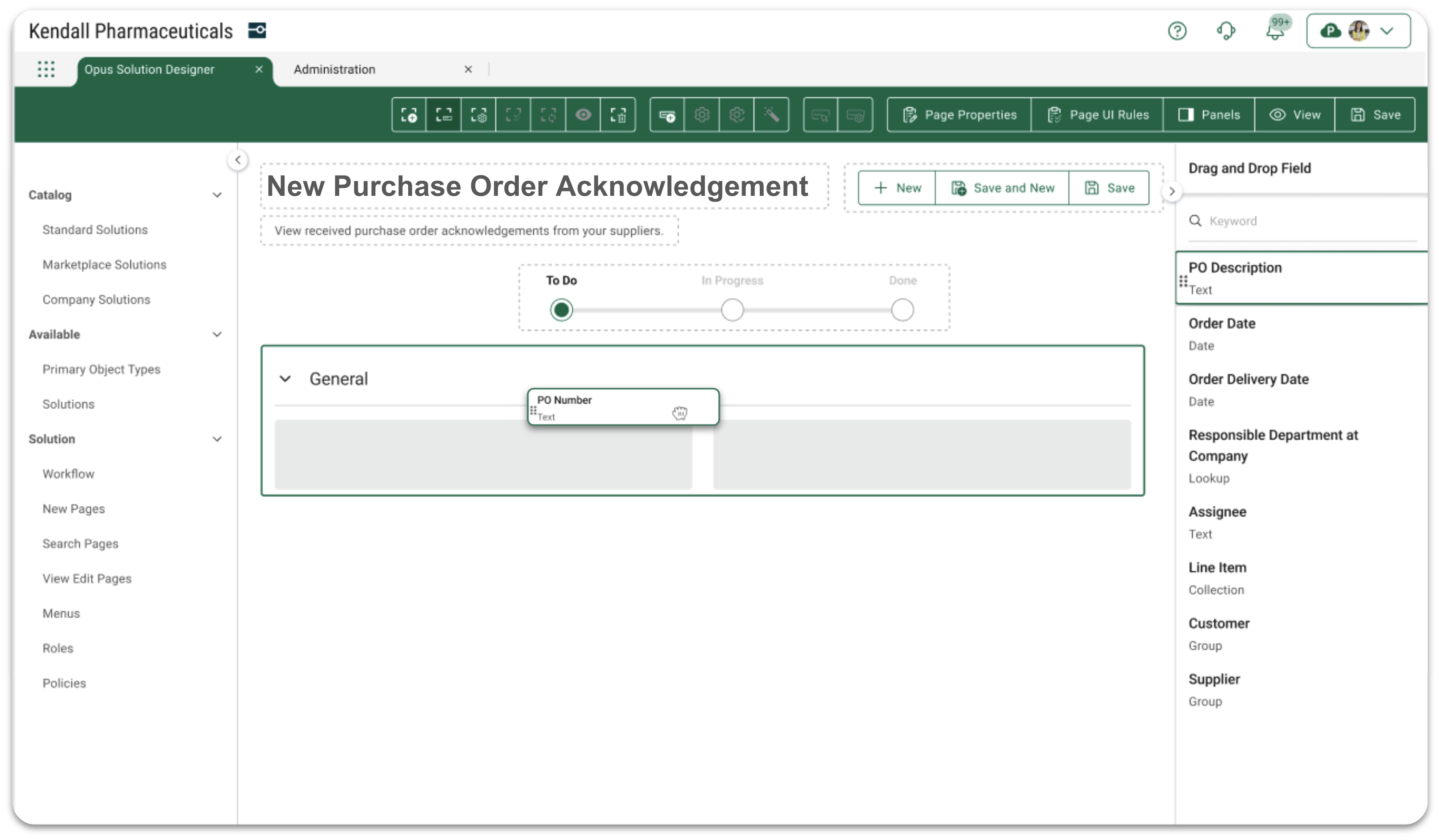
OPUS Solution Environment

Anthem is TraceLink's design system that establishes platform-wide design conventions to help you create and configure your solutions to meet your users' and business’s needs. The Anthem Design System defines how to use the essential framework, grid, styling, components, and patterns needed to design UIs, menus, and more on the OPUS Platform. This ensures consistency across all solution experiences, regardless of whether the solution is provided by TraceLink, TraceLink customers, TraceLink clients, or a Solution Partner, who builds and configures solutions on the OPUS Platform. Our goal is to empower users with a platform that emphasizes expediency, flexibility, consistency, and innovation.

This information is intended for anyone creating a solution with the OPUS Solution Environment (OSE). Users of OSE, known as Solution Designers, should follow these best practices and principles to deliver quality experiences across all solutions on the OPUS Platform.

Our design principles are focused on object-driven no-code products for enterprise and multienterprise use cases. These principles serve as the foundation for how to think about configuring business objects, workflows, menus, UIs, roles, policies, and notifications while guiding all of us in delivering effective solutions to complex problems for years to come. Welcome to a new era of no-code configuration, where your business needs are met with speed, precision, and creativity.

Expediency

In today's fast-paced business environment, time is of the essence. Our platform is designed to streamline processes, enabling rapid configuration and deployment. We’ve shortened the time it takes from having an idea (concept)  to seeing it on the screen (implementation), so you can quickly revise and iterate on your own.

Flexibility

No 2 businesses are alike, and our platform reflects this by offering configurable and adaptable design options. Whether you need a simple out-of-the-box solution or a more complex solution tailored to a particular problem, our system is designed to scale and evolve with your needs.

Consistency

A unified and predictable user experience (UX) enables productivity and user success. Our design conventions ensure that the experience is reliable and cohesive, regardless of the configurations or the user. This consistency helps maintain a seamless experience across different environments, products, and use cases.

Innovation

We are committed to continuously improving and staying ahead of industry trends. Our platform is unique in that it taps into the power of the TraceLink Network, which drives innovation across vast supply chain challenges. The OPUS Platform not only supports current needs but also anticipates future demands. We encourage companies to push the boundaries of no-code solutions, fostering a culture of creativity and forward-thinking.

Continue Learning Anthem Design Fundamentals

To start designing with OSE, you can explore the related resources below.

 

Table of contents

Related Content
Start Designing
Define and Design Your OPUS Solution With the Triple Diamond Design Process
OSE simplifies the creation of business objects, workflows, and menus, but the Triple Diamond Design Process ensures that your solutions are aligned with user and business needs, preventing misalignment and ensuring relevance.
View More
Workflows
Define and Design Workflows
This guidance outlines essential practices for designing effective workflows that enhance efficiency and flexibility in business processes, focusing on primary objects to help OPUS Solution Designers create impactful solutions.
View More
Roles and Permissions
Design Considerations With Roles and Policies
User access in a solution is managed through permissions, roles, and policies: permissions define specific actions, roles group these permissions for streamlined access, and policies enforce the logic that determines what users can do, ensuring data protection and security compliance.
View More
Opus Ensemble
OPUS Ensemble Patterns
Enabling OPUS Solution Designers to understand Ensemble patterns, which includes user context, settings, and browser-style navigation for streamlined access.
View More
Page Types
Understanding Page Types within the OPUS Solution Environment (OSE)
Page types enable Solution Designers to efficiently create user-friendly pages using a drag-and-drop interface, allowing them to organize information for optimal usability.
View More

Cookie Settings

When you visit any website, it may store or retrieve information on your browser, mostly in the form of cookies or similar tracking technologies. Please see below for an overview of the categories of cookies and similar technologies used on this site. You can allow or deny some of all of them, except Strictly Necessary Cookies which are required to provide the site to you. However, blocking some types of cookies may impact your experience of the site and services we are able to offer.

Please see our Cookie Policy for more details, including a list of the cookies we use. You can change your consent options at any time by following the “Cookie Settings” link in the Cookie Policy.
'Strictly Necessary' cookies let you move around the Site and use essential features like secure areas, shopping baskets and online billing. Without these cookies you would not be able to navigate between pages or use certain vital features of our Site, so we do not require your consent for their use. These cookies don't gather any information about you that could be used for marketing or remembering where you've been on the internet. For example, we use these Strictly Necessary cookies to identify you as being logged in to the Site. You can set your browser to block or alert you about these cookies, but if you do so, some parts of the Site will not work.
'Performance' cookies collect information about how you use the Site, such as which pages you visit, the time spent on the Site and if you experience any errors. We use performance cookies to provide aggregated statistics on how the Site is used and help us improve the Site including by measuring any errors that occur.
'Functional' cookies are used to provide services or to remember settings to improve your visit. We use 'Functionality' cookies to remember your settings and choices and show you when you're logged in to the Site.
‘Targeting' cookies are linked to services provided by third parties, such as 'Like' buttons and 'Share' buttons. The third party provides these services in return for recognizing that you have visited the Site. We also use 'Targeting' cookies to gather information that could be used to display content that we think may interest you.

Footer

  • Quick Links
    Get a Demo
    TraceLink Network Directory
    The Network
    OPUS Platform
    Technical Support
    Open Jobs
    API: Terms of Use
  • Products
    Multienterprise Information Network Tower
    U.S. DSCSA Compliance
    Targeted Recalls
    Process Orchestration for Empowered Teams
    Serialization
    Global Compliance
  • Resources
    Resource Center
    Events
    TraceLink University
    Partners
    Community
  • About TraceLink
    Our Story
    Newsroom
    Culture & Careers
    Leadership
    Our Values
    Corporate Social Responsibility
  • Hot Topics
    Transaction Integration
    Supply Chain Visibility
    DSCSA Compliance
    Process Orchestration
    Kazakhstan Compliance for Pharmaceuticals
    Kyrgyzstan Compliance for Pharmaceuticals
Follow Us on Social
Facebook
Linkedin
X
Legal & Trust.
© TraceLink Inc. 2009-2026 All Rights Reserved
Contact Us Today
Contact us today to begin your journey toward agentic supply chain orchestration — digitalize your end-to-end supply chain with intelligence, flexibility, and collaborative orchestration.
Contact Us
Stay Up-to-Date
Subscribe to receive industry insights and stay at the forefront of evolving trends.
Subscribe