
Table of contents

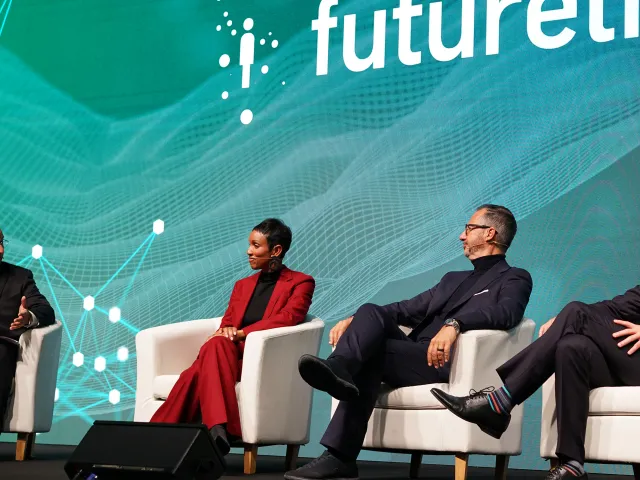
The shift toward agentic AI is forcing healthcare supply chains to rethink how they use data, align teams, and drive meaningful improvement. Anna Mansurova, Head of Healthcare Logistics IMEA at Hellmann Worldwide Logistics, explains why digitalizing core information, integrating systems, and unifying stakeholders around patient value are essential steps before intelligent capabilities can deliver real impact. She also shares how network-based platforms like TraceLink MINT strengthen collaboration and create a foundation for more adaptive, scalable orchestration across global healthcare logistics.
Key Moments
- 00:17 - How will agentic AI transform the life sciences and healthcare supply chain?
- 02:14 - What is the foundation for agentic AI success?
- 05:07 - How is Hellmann using AI today?
- 10:15 - What digitalization challenges has Hellmann faced?
- 12:10 - How does TraceLink MINT support agentic orchestration?
- 14:02 - What is your advice to peers embarking on a digitalization journey?
Watch the full interview above or explore some highlights below.
How will agentic AI transform the life sciences and healthcare supply chain?

The next evolution of supply chain performance will come from offloading routine work to intelligent systems. Anna Mansurova shows how agentic AI can accelerate familiar processes and open the door to more innovative problem solving.
What is the foundation for agentic AI success?

Agentic AI depends on the right people, the right systems, and the right mindset. Anna Mansurova explains how patient-focused alignment and a strong digital foundation work together to enable meaningful AI-driven transformation across the supply chain.
How does TraceLink MINT support agentic orchestration?

Anna Mansurova describes how TraceLink MINT creates the foundation for agentic orchestration by linking supply chain partners on a shared digital platform. She highlights how a broad, collaborative network makes it possible to improve visibility, support innovation, and give every participant a role in advancing a more intelligent, scalable way of working.
TRANSCRIPT
TRANSCRIPT
The first step to agentic AI to reach agentic AI is to digitalize. What does digitalize mean? Bring everything that you have onto the digital platform.
Yes, the benefits and the power of agentic AI is huge. It can automate a lot of routine processes and can speed up processes as well. Think about applications in drug development.
I think it's a very simple example everyone can relate to and it's already known. AI immensely speeds up the drug development. Brings down not only the timeframe of bringing new drugs to the market, but as well as the cost.
Taking that example and think what else can you do within the supply chain is just a way to think about it. Automating processes where a lot of repetitive decision-making is being done, for example, stock levels, reorder points, management of exceptions is all good examples how the routine supply chain processes can be optimized through agentic AI.
The benefit that would be not just optimizing what is known, but freeing up human capital where the benefit of creativity and problem-solving comes in, freeing up human capital to actually think about unknowns, think about how do we actually solve new challenges that the complex external world is bringing to our plate? That's how I see it.
Agentic AI is going to be there to automate what is known to us, what we already figured out, documenting it in a way and executing it in way and the speed and the scale which humans cannot keep up with.
Then human capital, human mindset, human intelligence to be focused more towards problem-solving and finding new ways to market, to supply chain, to build up a new way of executing supply chains for the new therapies that are coming onto the market.
The path to the agentic AI, and what the blocks do you need to have in place? There are many. Maybe if I can dissect it into technological way of thinking, then the human capital way of thinking and possibly then partnerships. Maybe those are going to be three dimensions.
Let's address the techy stuff, technological. Agentic AI is basically a way to analyze the data and make decisions in an automated way. First, you need to have the data. How do you get the data? You need to make sure you connect all the data points within your supply chain and bring it onto the one platform.
When you break it down that way, you understand that first, you need to know where your data sits. Is it integrated? First, you need to have a digital platform. The first step to agentic AI or to reach agentic AI is to digitalize. What does digitalize mean? Bring everything that you have onto the digital platform, starting with the basics.
Getting all the information onto your systems, making sure your company has systems that are efficient and integrated onto the one platform. That's a technological side of the path to agentic AI. Then there is a human path to it.
There is a lot of conversations in this conference about digitalizations, the projects, and the fact that a lot of them do fail. Why do they fail? Typically, it's because stakeholders are not aligned. There is no alignment between CIOs, operational folks, and the business folks. That could be one reason why digitalization projects fail.
Another one could be the fact that the particular project doesn't support the business need, and that's all it is. Business need, it means need in healthcare, which is the patient's need. You always need to be driven by what you are doing it for, and you're doing it for a patient.
With that, aligning all of the stakeholders and making sure that that digital project is linked to that final outcome and goal. Digitalization and topics like that needs to be driven from top down.
It needs to be a strategic decision to say, "As a company, this is how we add value to the patient. That's what we need to do, and that's how digitalization and agentic AI at the end links to that."
Once people understand how that all connected, what role they are playing in the bigger picture, I believe it's much more easier to get people on board to support the transformation. Because with that, people also need to change.
They need to change their mindset, they need to be more open to learning and to reinvent themselves because that's what we're all doing here.
Within Hellmann Healthcare, we've got multiple ways we think about digitalization and bringing AI capabilities into our playbook. Maybe a little bit of a context. In the Middle East or Indian Subcontinent, Middle East and Africa, Hellmann Healthcare is very strong with distribution activities and providing distribution center capabilities.
It means we are very, very close to our customers. It means our relationships are long-term relationships where we truly can collaborate and be partners. What does that mean as well? Is that they come to us with the problems, and problems to which you need to find a solution, which also you have time to work on.
What it means is that you could first of all brainstorm on what and it could then really invest in the capabilities. That helps us to do that because we are not in a transactional business, we are in a relationship which is long term.
I'll give you an example. In emerging markets, or developing markets, or rapidly-growing markets, companies are always looking at the different business models how to serve the market, how to reach patients in a better way.
An example could be a direct model, where you simplify your supply chain and you distribute directly yourself as a principal company, as a manufacturer. What it means is that you start to have a direct connection to the final product users, let's say hospitals. You might not get to the patient yet, but to the hospitals.
How do you then make sure that you collaborate with the hospitals in a way that is efficient and you can get all the data back in? You start to think about what is the digital platforms you need to have to connect all of the stakeholders in that final mile piece, how that could look like.
With that, we think together with the customer and say, "OK, what type of solutions do we need to do for that? Do we go point-to-point?" Hellmann internally has very strong capabilities on integrating the systems, but they are point-to-point. Is that the right solution?
For example, our distribution centers, they are connected point-to-point, and that's pretty OK. When you start to think about network and creating a final mile distribution network for your customer in a market like United Arab Emirates, you start to think the network. Can Hellmann actually do it point-to-point? Can hospitals integrate with you point-to-point?
Do they have capabilities? Is it easy for them? Maybe there you need to go outside and look for partnership software companies like TraceLink that can offer such solutions.
That's one example, and I think that's the most complex example of applications. Another one that could be very targeted and process-specific, for example, they might say, "Look," my customer might say, is that, "I want to make an on balance decision. What transport mode do I want to use after I prepare my shipment in your center?
"I want to balance. I want to make a good decision on balance to take into consideration cost, to take into consideration speed, risk management, the information that you get through with risk assessments, and as well as impact on the environment CO2.
"Taking those four key criteria, urgency of my shipment, my tolerance to cost, how much I can pay for it, the risk of temperature excursions, and then impact on the environment. I want you to recommend for me what is the best way to ship this product."
Again, you can do that as a person, as a human, Excel sheets, calculations, but imagine what a targeted digital AI-enabled agentic solution can do for you. It can deliver answers in a click of a button or a flip of a finger. That's another example of a targeted solution where agentic AI, as a final stage of maturity, can bring a great value.
Obviously there are internal processes, like every company is looking into how do I do my documentation faster? In our region, you need to customize a lot. Market A will need to have this documentation, market B another documentation, and then how do you automate that to be more efficient?
How do you automate your warehousing processes to process your shipments inbound, outbound faster? Then AI applications like visual AI scanning that reconciles count of products to your expected ASN information can really, really help.
Multiple examples, again, going back from the most sophisticated network example of final mile connecting all the stakeholders, then coming back to the specific solving logistics question that customer has on optimization of their impact, and then coming to the internal processes optimization, like how you run your warehouse in the most optimized way.
When I think about the challenges of your digital journey and getting most out of capabilities that are coming to all of us with the implementation of AI and agentic reasoning capabilities, you obviously think, how are you being relevant? There are so many projects you could tackle. How can you create an impact? How you can create a solution that really, really, really matters?
Sometimes as a business person, you don't have those capabilities to develop those digital solutions. You need to speak to the folks that are there in the digital world talking network of startups or companies like TraceLink that understand the technology.
Connecting the business need, the patients' need, the evolving world around us with the digital capabilities, digital knowledge, what is out there, and together, finding the best answer, that will be a challenge. How do you marry those three to bring forward truly solutions that's going to make an impact?
Within Hellmann, for instance, I could reflect how we are structured. We've got something called Innovation Lab. Those folks, what they do, they are very digital savvy, tech savvy, and they also have a good network of connections and connectivities to the startups that play in the technical field, AI field.
They scout, they talk to those companies. People can get carried away by talking to a number of companies, but connecting the solution that a technological company brings you to the actual patient requirement is an important piece.
This is where it comes, this organizational alignment, alignment of business units within the company to the main point, which is bringing solutions to the industry, to the patient, and drive that together, to develop that together.
When I reflect on capabilities of the MINT solution that TraceLink brought together, I was really wowed. [laughs] Our partnership with TraceLink at the moment revolves around track and trace.
Understanding more about how TraceLink innovated and took it further with the MINT solution, I believe it offers great opportunities to connect, to create end-to-end visibility. I always had the question in my mind, which part of the supply chain needs to create this end-to-end visibility? Who's going to own that platform? Who's going to come forward with this technology?
Throughout the years of my collaboration with my customers, a lot of them tried to bring end-to-end platforms, but it never works if one company just tries to bring end-to-end networks. I never found a use case where one company has been successful. I really think it's a network game.
That's what TraceLink brings along. You bring a network. You democratize this. It means anyone can play along, but with that also, you gain a great value because supply chain, you're connecting the world. You're connecting the world, and the world consists of so many companies and so many players.
That's the power of network, that's the power of TraceLink. That's one of the components is means, one of the solutions that you bring on board. That's really, really powerful.
I know it's the first step for TraceLink as well, and there will be point two, and point three, and point four. I look forward how together, all the supply chain players can collaborate with TraceLink to improve that platform.
The advice that possibly comes to mind for the companies who would like to start digitalization journey would be following, start with the basics, understand what the basics are. That, again, comes back to the data.
Where is the data sits in your organization first and then in the businesses that you serve, and then that wider end-to-end? How do you get this data together on one platform, or a couple of platforms, and how do you integrate them to bring it all to the same piece? Really think about how do you get the data.
The second piece is that how clean is your data, how meaningful is your data? A lot of companies have the data but it's not relevant any longer, and it might be incorrect.
Also think about how do you make sure you maintain your data clean? Master data, for example, product information, transactional information because that brings you on the same language. That's the base. From that base, then you can innovate and you can put layers of different applications like agentic capabilities because first, you need to have your bases.
That's the technological side of things. Coming back to everything we discussed at the right, there needs to be a reason why you're doing this. Be very clear why you're doing this. It's not just because everyone talks about digitalization, everyone talks about AI, and you need to have something in your use cases or something to be able to talk about.
I think you always need to have a question why are you doing this, and be very, very clear. You can create it, but if it doesn't bring value to the end user, it will also not bring value to the company. At the end of the day, we're all driven by creating value and also being able to monetize it. It needs to work as well on the business front.
First of all, be digitally ready. That means get your house in order, get all your basics right, and be very clear what you're trying to achieve, what could be the use case, what could be the first project you want to work on.
Get the pilot project out, prove the concept, deliver the results and the value to be seen to the C-suite to continue them to support your strategy.