
Table of contents

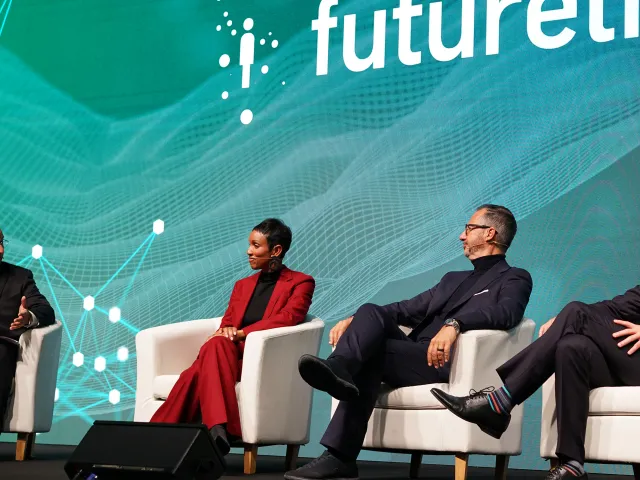
Transactional supplier relationships, siloed data, and increasing pressure on already-stretched supply chain teams are no longer sustainable. Torben Weilmuenster, Head of Supply Chain Management at Merz Pharma GmbH & Co. KGaA, explains why pharma supply chains must rethink how they collaborate, share information, and prepare for volatility. He outlines how digitalization and agentic AI will become essential for crisis readiness—shifting teams from manual execution to high-impact decision-making—and why unifying IT, supply chain, and external partners around a shared vision is critical for building a more resilient, intelligent operating model.
Key Moments
- 00:20 - What are the biggest integration challenges across supply chain partners?
- 01:18 - Why is a shared single source of truth critical for supply chain partners?
- 01:54 - What supply chain digitalization benefits are often overlooked?
- 02:42 - What does supply chain transformation success look like in three to five years?
- 03:20 - How can agentic AI help with decisions across the supply chain network?
- 04:12 - What is your advice for building stronger supply chain partnerships?
- 05:03 - What makes supply chain and IT collaboration challenging, and how can it be improved?
Watch the full interview above, or explore some highlights below.
What are the biggest integration challenges across supply chain partners?

Supply chain integration breaks down when companies treat suppliers as vendors instead of true partners. Torben Weilmuenster explains how transactional, top-down relationships create avoidable friction—and why shifting toward genuine partnership is essential for smoother, more collaborative operations.
What does supply chain transformation success look like in three to five years?

Torben Weilmuenster describes a near future where AI agents handle routine operations, enabling supply chain teams to focus on high-impact decisions—particularly during crises, when precision matters most.
What makes supply chain and IT collaboration challenging, and how can it be improved?

As supply chain and IT teams balance numerous initiatives and new technical requirements, collaboration becomes increasingly complex. Torben Weilmuenster highlights how a common vision for the organization helps both functions stay aligned and deliver stronger outcomes.
TRANSCRIPT
TRANSCRIPT
In my mind, the biggest challenge of integrating across companies and networks nowadays is still that we like to think of a supplier as a contractual partner to fulfill a certain need. Instead of onboarding him as a true partner that you engage in a partnership to reach a certain goal, it's still a supplier.
It's a, I guess you could say, top-down relationship, and then you hinder yourself in certain ways. That is a challenge that we have internally and externally.
Internally, we have sourcing departments that negotiate contracts, looking for the best possible price and not necessarily a great partnership. Then, externally, a supplier feels a certain pressure arising out of that. It's a self-made problem, so to speak, but we're still in that mindset in many, many areas. That's, I think, a large hurdle to overcome.
I'm a strong believer in...It's super important when you're in crisis mode because you don't have the time to assess, evaluate, double-check.
If you are in standard operations, smooth sailing, it's not that important because people know what to do and systems can guide you to do the right thing. In crisis mode, you can't work through a crisis with inaccurate data. That's imperative.
When it comes to automation and digitalization, yes, transparency, speed, agility, flexibility are buzzwords we hear all the time. I look at it, a little bit, from a different angle because, as I alluded to earlier, we have more people leaving the workforce than joining the workforce. That problem is going to become more pressing in the next few years.
From my point of view, this is our only escape route. We have to digitalize. We have to automate. All the transparency gains and that speed comes with it, but I think we have a much bigger problem than we can tackle with these technologies than just the transparency and the speed.
In the ideal world, in three to five years, we would have our supply chains digitalized. Maybe not 100 percent. That's probably a little bit too optimistic, but give it 95 percent, and we have all the, at minimum, standard operations handled by AI agents.
Of course, the job profiles of current, whether it's a supply chain planner or purchaser, will have changed from just executing to supervising agents. That would be pretty exciting.
Agentic AI, for me, is the opportunity to focus on the things that matter. Agents and agentic AI technologies will help us get rid of all the noise. We can then focus on what is necessary to focus on, especially, and I said that earlier, in crisis mode. This is what we're all preparing for.
We're not preparing for standard operations. Well, maybe a little bit to make things a little bit more automated and smoother, but in the end, what we always do is we prepare for the next crisis. How do we manage the next crisis? If we are enabled through agentic AI to focus on the small things that change something in that crisis, that would be game-changing.
The advice that I would give is go out there, speak to the people. Talking to your partners, you can also speak about how we deepen our technological relationship. That's definitely one part. Still, they will only give into that task once you have established a good personal relationship, and that still matters a lot.
The mutually beneficial thing is our value is their value as well. If we can automate our collaboration for all the standard activities, like cutting a PO, you're acknowledging all of these things, if this is handled by agents by automation, it also frees up his capacity. It is a win-win on both sides.
Collaboration between the functions, IT and supply chain, is quite a challenge, simply because there are so many projects running in parallel. You immediately run into a lack of resources.
We're not just speaking about the next rollout of something. You need experts. You need data experts. You need people that are super curious about learning new stuff because this has not been here before, AI and all that. You need very specific elements in such a collaborative team that aren't readily available. That is a challenge that we need to work on together.
What helps, I believe, is a joint vision of what is our ultimate objective, not the objective of the IT department, not necessarily of the supply chain but of the company, and that should unite everyone.